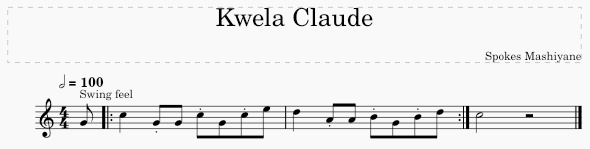
Kwelani Isitimela1
I have been wondering about how you actually got started with music. Was it at College in Pietermaritzburg? Or before that? And if so, how did you get into jazz? How did you get the connections in order to have ever heard anything about this? I did not think to ask before.
I have great memories of when I was a child of the odd few black men, all dressed up on Sundays off, who would stroll along the road past the boarding house on Sundays, strumming a guitar or blowing on a whistle—the repetitive notes and steady beat. I was fascinated with the discs in their ear lobes and the beads they wore. The women in earthy red headdresses and beads and metal anklets, I think they were brass. I think perhaps the men also wore bands around their ankles?
It was a lovely sound drifting down along the road. It went with Sundays—a leisurely, peaceful feeling. I have never heard anything like it since we left there.
So wrote my longest-standing friend, the late Patricia Whitbread, born Patricia Waugh2, in an email in March 2013 from Zambia. Many people have suggested I set down this story, but Patricia asking—since we go back that far—drove me to think—and do3.
The thing is, where Pat asks how I actually got started with music, it’s the other way around: music got me started. I was physically active, driven, but not knowingly very alive nor aware of feelings, before music stirred in me. Life was a passage of function, not sense. And it wasn’t really music as we thought of it back then that stirred in me. It was that difficult to define thing called ‘rhythm’4
What I love even more about Pat’s question is that she remembered exactly what I had remembered. It felt great not to be alone in recalling those memories of the dapper minstrels who came to be known as maskandi, a contraction of the Afrikaans word musikant.
The Cooks in PMB
My conjecture has always been that TJ had followed his heart up-country, fairly sure that he would find Alice Allen Orren in the Kimberley area. SA was a very small literate society, and he would have known she was already the widowed Mrs JW Corrie though I am unsure he would have known about the boy Albie.
As related in the Cape Town chapter, he did find Alice Ellen in Douglas. They traveled to marry in Cape Town, and she thus returned as Mrs TJ Cook, no longer Mrs JW Corrie. They did not stay even three full years in Douglas after marriage. TJ Cook left Douglas after a court case there. He probably felt all washed up there, and I think PMB was a natural fit for him, given his experience in Grahamstown, on his way ‘up-country’. It would not have felt as good for Alice Ellen. Douglas, despite being on two rivers, is famously windless, and much drier country than Maritzburg, and my grandmother must have felt qualms about moving to a moister climate. She had struggled with consumption even as a baby.
In time TJ was to become a sub-editor for both the Natal Witness and The Natal Mercury. He found a smallholding in Claridge, on the Greytown line, enabling him to commute. My dad said that he worked at both newspapers, one in the morning, the other in the afternoon 5.
They will have arrived in time for celebrations around SA becoming the Union of South Africa on 31 May 1910. It is a little weird to think that PMB, even today, has no such thing as passenger rail, neither commuter nor main line. As my father recalls, Natal Government Railways was, on paper, absorbed into South African Railways at Union, but in fact, the Claridge line and most others in Natal continued operating in Natal Government Railways livery, and NGR signage and livery were only really fully replaced by midway through WWI, in 1916.
My father spoke a lot about the Claridge place. It seems that TJ Cook, influenced by his beekeeping series in Grocotts Daily Mail in Grahamstown, became a beekeeper in Claridge. I was not given any detail about that, for example, though he was usually precise and detailed, said nothing about the processes of extracting royal jelly, honey and beeswax. He was born in 1909 in Douglas, was a child in Claridge, and spoke only of his brothers, Owen and Albie. They would have arrived in PMB in time for celebrations on SA becoming the Union of South Africa.
He enjoyed train travel with his father, and remembered finely dressed middle-class Zulu speakers dressed in Victorian finery on the train. They were from a quite large group now known as amaKholwa (believers), all of whom were well educated 6, and many of whom were land- and small-business owners, and generally regarded by both my grandfather and father to be exemplary in dress, character and bearing. By the time I was a child in the same town, they had all but disappeared. That is not progress.
There were Indian commuters too, but they were rare. This may have been in part because of the shameful blot in the history books on how Ghandi was ejected from a first class carriage in PMB. My father was astute enough to figure that there was a de facto boycott of trains by Indians in place. Half a century later, when I shared a compartment on the Trans-Karoo, an Indian train enthusiast (from India, not South Africa), queried the lack of South African Indian passengers on that train, and I wised him up on that sad historical note. He was a fan of Indian rail, understandable given that Indian railways are the fourth largest in the world, and the second largest after China that are operated by a single government management. Britain threw that away, are trying to get it back again, but who knows whether they will ever regain true control. As a nation, they appear better at fragmentation and tinkering than they are of uniting anything at all.
My Indian travel companion had read widely about South African Railways, and had traveled all over Africa by rail. He had not come across anything anywhere in sub-Saharan Africa remotely comparing with our rail system, but, then, in the mid-nineties, he was already dismayed at what he saw was a once proud railway system dismantling before our eyes. He was unsurprised that Indians stayed away from rail in South Africa. That was not true of the commuter routes on the Natal North Coast, where one saw Indian commuters, but mainline trains never recovered from two things: one was Ghandi, and the other was that Indians were not even allowed in the Orange Free State. Who can blame them for quietly erasing rail from their mindset? It is the appropriate, dignified response.
The Cook family moved to town when Alice Ellen passed. She had battled with ‘consumption’ even as a baby.7
My father went to Marist Brothers (St Charles) College, where he came to be known as “Asia” Cook. The name came from a French Marist brother, who pronounced his first initial “H”, as “Ayzha” - the “zha” part being really more like the soft “g” in “genre”. He was sport crazy and did not pass matric, something that turned into a hard lesson later. He emerged from school straight into a declining economy, leading into the crash of ‘29. He improved his prospects by studying matric by candle-light in huts around Elandskop on the Franklin branch line. Stripped to the waist during the day, working on logging and in sawmills with Zulus, he learnt passable isiZulu, leading to later enjoyable relationships with Zulu peers in the Colonial Service and Natal Education Department.
He must have left school around 1926. It was something he did not enjoy talking about. Working in labour was regarded as infra dig for whites, and although PMB was the capital of Natal, it was in every other way a farming town. As far as I can make out, there were a few trends ruling the his job-hunting failure. They are quite relevant still today, because of two main things: scarce jobs and a gloomy economy, both of which we suffer from today. The scarce jobs problem was different back then. It was mostly due to a collapse in agricultural commodity prices, and not a single firm was hiring when he left school. The other factor was to do with with Herzog’s stubborn refusal to leave the gold standard, though my father said little about that.
What he did say was that SA was in the control of a pact government at the time, and I never forgot that. Our current so-called GNU (Government of National Unity) is a similar plan, a coalition trying to save things. Things are different: Herzog’s delay put us behind other colonies revaluing currencies to make exports cheaper, so we took longer to recover. In those days, to leave school was to leave home. That was unquestioned.
My father and his brother Owen, enjoyed a brief, feckless period of partying, as we all do, but soon things got desperate. He acted quickly, using those years to get his matric. Still, it took several long years on the slopes of Elandskop before he gained the prized civil service job, itself a part of a process to make a professional civil service and put into motion by Prime Minister Herzog. The government was a hirer’s paradise: only matriculants could get a job, and standards were steadily raised before they began to decline again under the Nationalist Government.
His whole career story is a tragedy in its own way, culminating in his death from cancer that had the optics of an embittered suicide. At one stage he was sixth inline for Provincial Administrator, only to be leapfrogged by a succession of Pretoria plants who were so useless at their jobs that they would phone him at home at night and even while he was on leave, to find out how to proceed with work that was plainly laid out in civil service manuals and gazettes.
They were good “party” people. Does this sound familiar?
Penny Whistle Blower
As will unfold, I started my musical life as a penny-whistler: at heart, I remain a whisle-blower!
Music is Melody, Harmony, and Rhythm. I count myself very lucky to be SA-born, given that our music is rich in harmony (most of our children are singing in harmony before they reach school), rich in melody, and full of throbbing, irresistible rhythm. Classical music, to me, was poor in rhythm, though strong in melody and harmony. There is an “attack” to swing and jazz that classically trained musicians found challenging, and that they were actually trained away from. Many, when trying to play swing or jazz, sounded terminally corny at worst, and too polite at best.
In my thirteenth year, and having migrated from penny-whistle to trumpet, just minutes after ripping off a creditable passage from Haydn’s trumpet concerto in E-flat (on my B-flat trumpet), the orchestra conductor, a young Mr Chamberlain, said appreciatively:
“I suppose you admire and regard George English as your influence?”
“No, sir. My hero is Louis Armstrong.”
His response was violent, a finger flung, pointing to the door:
“Get out! OUT! GET OUT OF THIS ROOM, IMMEDIATELY!”
Thus ended my classical music experience. Mr Chamberlain surely did many good things in his lifetime. One was, he made me never want to play anything like classical music ever again. I would never again murder the classics, and his classical players would not murder our marabi/mbaqanga. “Good trade!” as Lt John Dunbar might say, when not dancing with wolves.
I’m not alone in my classics-discomfort. Once, rehearsing with “Zimology” Zim Ngqawana—with whom I had briefly studied under Darius Brubeck at the University of Natal, Durban—the subject of the “even-tempered scale” came up, I don’t know how. Zim thought about that for a while, then his face puckered into laugh lines. He said:
“I don’t know about the even-tempered scale, Bra Jasp. I tend to stick to the bad-tempered scale!”
I often got a laugh out of Zim. One day, I told him I’d always known he would be a band leader. He asked “How’s that, Bra Jasp?”. I stood, began swaying in time, clicking my fingers, and said “Ngqawana, ngqa-two, Ngqawana two three four”.
As a child, I was musically inert, until eight years of age, when I saw Jeff Guy blow an alto sax. there was no notion of music as a livelihood, nor did even want to think of it. My dad thought it “wasn’t a job.” He put it to me that chopping wood was a job, bricklaying was a job, clerical and accounting work were jobs—because people saw and could assess value by counting completed tasks, and were happy to pay for them. He thought musicians were largely happy to play for a drink or two, and had not too many good words to say about the only professional musician in Pietermaritzburg in those days, a man named Bill Wright. Mr Wright’s nephew, Alan, later confirmed that making a living in a town as small as Pietermaritzburg was in those days was a hectic challenge for his Uncle Bill. We both agreed it was not all bad, though, to live one’s dream.
When music as a profession happened to me, it was an unplanned surprise. I had, in my mind, good reason never to become a musician, but… stuff happens. Who does one finger? Whose “fault” was it that I became a musician? Some arrogant dolts in a shipping company? I suppose so. What follows is a non-forensic look at the skid marks left while traversing at least one plane of this flange of existence, or the story of how this Cookie crumbled. Or didn’t.
Patricia Whitbread mentioned Mbali township. I was not yet aware of it until I returned from England in 1971. She would have been more aware of it because it arose across the valley beyond Bizley, the shooting range, close to Oribi, where the Waugh family moved when they left Burger Street.
The only townships I knew at all growing up were Sobantu Village, to our east from Burger Street, and Edendale, further out of town than Sobantu, and to the west. I knew Sobantu from passing it many times on the way to Bishopstowe, though I realised only this year, from reading Jeff Guy’s book The View Across the River, that Sobantu Village was named after Bishop Colenso. Colenso’s Zulu nickname was Sobantu. The Colenso homestead must have been on the same hill as Hackland’s farm, where I spent many weekends while at primary school, but a bit further around to the north, where they would have had the view mentioned in the book of the local Table Mountain. I ran to, and climbed, that mountain a fair number of times during my teenage years, including once in bright moonlight.
From these earliest memories, of being hooked by the timeless, repetitive cycles of chords rendered by the minstrels of the time, there is not much to outline by way of a timeline for musical development. I was not that conscious of a preoccupation with music. When I finally got to music at about eleven years of age, it felt so natural, as a part of life, as to be “the usual,” and I thought everyone was the same as me and must therefore be dabbling in or performing music.
The greatest teacher I ever had turned out to be my brother Al. He had started out listening to classical music when we were still living in Burger St. Always tending to extremes, at that point he hated jazz, or just about anything that was not classical or opera. He would spend his pocket money largely on records. In those days, that meant 78rpm vinyl discs. He frequented bargain tables in Theatre Lane, where he would buy up a “lot”—a bunch of records for a very low price without knowing what was included. That was the deal.
One Saturday, he brought home one of these “lots.” Untying the coarse brown thread, he discovered a record by someone named “Lionel Hampton.” He and Effort listened to it (about three minutes of music, the standard for the time) and condemned it as utter trash. They took it out onto our lawn, where Al positioned himself with the intensity of an athlete, then hurled the disc as far as he could. They were thrilled. Al was a long-time model aircraft maker, with a large collection of balsa and doped-fabric warbirds suspended from the ceiling of his bedroom: FW190, Stuka, BF109 (he greatly admired anything German), and their British and American contemporaries like the Hurricane, Spitfire, De Havilland Mosquito, and Curtiss P-47.
Later, some postwar models appeared: Fairey Gannet, De Havilland Vampire. His last model was a MiG, with a Jetex solid fuel engine, flown once on the Merchiston sports grounds, where it caught fire mid-flight, crashed, and burned. The Lionel Hampton disc turned out to have better gliding and flying characteristics. That vinyl airfoil arced gracefully over the lawn, crashing into shards of vinyl against the back fence. Such delight. Effort and Al cackled with laughter, and the episode was recounted to friends many times.
One day, included in a bundle was a Glenn Miller record. I can’t remember which for sure, but I think it was “American Patrol.” Al was hooked. He went out and bought more Glenn Miller. By then, his new turntable, a Garrard with a diamond stylus, was put to endless use, with “In The Mood” and all the other Miller hits following, and then he discovered Benny Goodman. “Sing, Sing, Sing” and the Carnegie Hall concerts got a huge amount of air time at home. Other jazz fans trickled in: even if they weren’t as fanatical as Al, they liked what they heard: Louis Armstrong, all the swing era greats. Not long before we moved to Scottsville in 1957, he had two visitors from UNP: Bill Ainslie and Cathy Shallis. Cathy is now Cathy Brubeck.
Al did nothing by halves. Having switched from classics to jazz, boots and all, he was horrified one day to read in Down Beat that the Lionel Hampton 78 he and Effort had test-flown was actually a limited pressing and had become a very valuable collector’s item, worth a lot of money.
Country – City: A Conflict
Given that music is mainly an urban living, I was not cut out for music as a living, no matter how much passion I felt for it. My earliest memories are of rural settings, both Swaziland and the Karoo, and those locations were where I and my siblings found the happiest days of our lives. Most of our childhood holidays were in the Karoo. Two were in Swaziland. Both locations left me with no particular attachment to Pietermaritzburg, nor for that matter to any town or city. This love for the open spaces is more easily satisfied by the Karoo and its vastness than it is by Swaziland, but I had a love for farming too.
Right through prep school, my holidays with my besties—first Donald Hackland, and later Eric Hobson—were on their family farms. So, farm holidays were not only a Christmas thing, they were a feature of all my holidays. Most of our ancestors in SA were once farmers. Very few early settlers were “townies” because that wasn’t what their recruiters wanted to put on ships. They wanted farmers. So, my “story” itself felt more like a rural than an urban one. Music only appeared in my life in a biggish way toward the end of prep school. The fascination was even more with soil, improving and protecting it, and that has not left me in all of my 77 years. My godfather, Malcolm Hensley, was a soil scientist at UOFS, and worked on well after retirement there.
Karoo farming is more about exploiting animals than growing things (not much will grow in the very cold winters), but being intelligent about using and conserving what ground- and rain-water one has in the Karoo marks the difference between survival and going under.
My Grandad Every was a very intelligent man. My earliest memories include drives in his Ford bakkie, all over the farm. On one of our many road trips together, my mother outlined to me how her father had carved a living on what the local farmers said was a farm both too small and too marginal to make a living on. The first thing he did on moving to the farm Vinkelfontein was to build their house, quite a big one, to replace what was already there. He then built the milking sheds, pig pens, and chicken house. For the first seven years, to allow the veld to recover, and while he built up savings to buy sheep, the farm was left to springbok only. His neighbour on the farm Brimscombe was Abe Pepler, a well-known Merino breeder who had improved his sheep bloodline by importing Merinos from Australia.
Grandad Every laid out lucerne lands, bordered by irrigation furrows, with tamarisk trees8 lining the furrows. When I visited Vinkelfontein in the 80s, it was being run by farming staff. We had a look at the house, empty of all furniture. The strangest thing for the adult me to observe was the waviness of the walls. They were not purely and strictly straight and perpendicular to the ground with the precision of modern homes. Looking at the plastered, white-painted walls, I suspected that underneath what I could see was actually stone masonry instead of bricks. That would make sense: the house was up against a small range of koppies that were strewn with spherical rocks. There is no shortage of the right size, between an apple and a quince or grapefruit, so the biggest cost item would not be bricks but cement. Where he sourced the roofing, I don’t know. It could have been gum poles, not the smart trusses we are accustomed to nowadays.9 The roofing structure was invisible, shielded by a cladding of ceiling.
We strolled through the gardens and had a look at the huge dam he had built, as well as a few peach tree and willow-lined satellite leidamme, and wandered down the furrow to the lucerne lands. The tamarisks had been coppiced for thirty years, and still, the headman told me, provided ample firewood for staff throughout winter. Grandad himself did not rely on wood for heating. He ordered a lorry load—a few tons—of coal every year from the Witbank coalfields. It must have been, or included, anthracite, because I can still remember the dull orange glow through mica panels on the heater. Every house seemed to have one of those back then.
Lucerne fed the Jersey and Guernsey milk cows. They were unheard of in the Karoo in those days. He kept them for their high-cream-content milk. He also successfully fed chopped prickly pear leaves to his livestock. In one of the many jotters he used for his records, he wrote that he had successfully maintained livestock condition through droughts, cows keeping condition for 550 days, and sheep for 365.
He sold cream to the Queenstown Dairy. We loved the ride with him in the bakkie to Noupoort.10 Railways were still very much a real service to farmers back then, and the delivery of cans was overseen with a fairly leisurely catch-up on the news. The loadmaster had been there for years, knew everyone and what to do with their produce, and knew the paperwork:
“Los alles sommer hier, by my.”
So it was a brisk enough turnaround trip not to make us kids suffer much in the heat of the day. Skimmed milk was fed to his pigs. Their litters were fattened and sold as baconers or porkers, according to the whims of the market. Chickens kept my grandparents in both table meat and a steady egg supply, so we ate everything fresh. I have not tasted chicken like that in decades since. They didn’t buy much food from town: flour, sugar, seasoning, spices, tea and coffee, clothing and shoes. Everything else, they had, or made. Granny preserved fruit for the winters, and she baked. Although Grandad had milled his own wheat while managing the farms “Lorraine” and “Amherst” in the Kat River Valley, he had no mill on the farm. Strong water or wind is needed to drive a millstone, and neither was a constant in that part of the Karoo.
Railways were a service to farmers back then. You could do a lot with rail: for a few years until he retired from farming, Grandad culled his springbok herds yearly, and sent one carcass to us by rail in Pietermaritzburg. At perhaps eight years of age, I was on our front verandah when a man in a brown coat entered our front gate, hefting something on his shoulder. He dumped it on the shiny red grano. Its horns clattered. It was a springbok, belly opened and cleaned, but otherwise intact, railed to us from Grandad.
I can never forget the beauty of the animal, up close like that, though the milky eye was disturbing. This can’t happen anymore. For a start, the railways have dwindled to a specialist bulk goods service, with few but long trains per day, now concerned only with carrying bulk ore coastward and cars inland.11 For a second fact, the line bypasses Noupoort, now a more or less dead dorp forsaken by its rail lifeblood and origins. There is not even a goods shed attendant on the station, nor even a stationmaster. Nor would anyone be tempted to believe that shiny-eyed kids waited in chilly waiting rooms for their grandad to arrive to collect them around five in the morning. It looks that forbidding today. I doubt today’s health regulations would allow a consignment of a springbok (or any) carcass today.
In the event, my mother would phone Cecil Glasson the butcher, who would send a man on a bicycle to collect the buck. Often, that man on the bicycle was the powerfully built and gentle John Ndebele, who doubled as gardener for us at the Burger St house. Their deal was Mr Glasson kept the horns, feet, pelt, and a shank or two, in exchange for butchering the carcass into cuts. So, for a short few weeks in a year, we enjoyed springbok venison dishes. Favourite was roast leg, but my mother made braised venison and stews out of the smaller, more bony cuts.
Music was seldom heard on the farm. Granny liked peace and quiet. Once only I sang something in her presence, at which she said, “You are flat,” in just such a flat tone of voice. I was careful not to try that again. There was at least some music on some of the train trips to the Karoo, the most memorable of which I chanced upon out of curiosity by exploring the train.
Those passenger trains were very long, usually sixteen coaches or more. Coaches were made of wood, back in the days when “coach-builder” was a respected trade. The compartment panels and bunks were made of teak, varnished to a high gloss. Upholstery was in green leather for second class, blue leather for first. We looked forward, each annual trip, to the sepia photographs of scenery from around South Africa. These appeared to be on the compartment walls, but were actually mounted on the underside of the upper bunks. Those sleeping on the bottom bunks could continue to admire “The Golden Gate, Clarens, OFS”, “Valley of Desolation, Graaff-Reinet”, “Amphitheatre, Drakensberg, Natal”, or “Bloubergstrand, Cape Town, Cape Province”, in the gloom as they lay, waiting to fall asleep, rocked by the train12.
The windows (etched with a springbok head graphic in the centre) could be opened right down (not always easy, sometimes jammed); there were slatted louvre-style wooden shutters as well as a fabric blind. The wooden louvre shutter was pleasing in that it made the compartment very dark and shady when down, and let in the breeze when windows were down, cooling us off in baking December days and nights.
Each end of the coach had large water bottles strapped into an alcove, with a tap. We would take a tin mug and help ourselves. At the coach end was a balcony, a roofed three-sided wooden picket-fenced area where we spent most of our time. We were careful of the steel buffers (my dad had shown us the danger) and never had any accidents. In those days, everyone looked after everyone, and my parents did not worry too much as we walked up and down the train.
The first, overnight section was electrically pulled, from Pietermaritzburg through to Harrismith. The big excitement was to see what class of steam locomotive would pull us from Harrismith onward. My dad had separated locomotives into two classes: “Flyers” and “Pullers”. These two corresponded roughly to Pacific types with 4-6-2 arrangement as flyers, and Mountain types with 4-8-2 arrangement. By the mid-fifties, we were pulled by what were then fairly new Class 15F and Class 23 locomotives. Both classes were nearly identical to me. These would pull us to Bloemfontein, where a variety of classes were used in the less hilly terrain for the rest of the journey through the southern Free State and across the Orange River into the Karoo. From time to time, we were given what my dad called a “flyer”.
Once, on a trip in our teens, our coach was forgotten in the carriage yards in Bloemfontein such that the PE train left without us. A massive quarrel between my irate dad and the Bloemfontein stationmaster ensued, and a special train was made up to include us and sent on its way behind a Class 16E—shiny and new with its high-stepping six-foot driving wheels, the largest of any locomotive in SA rail history. The resulting trip was major fireworks, with my dad edgy and hanging on for dear life as the driver sought to make up time.
Crossing the steel girder bridge on that trip was a noisy affair at the speed the driver took it, making a charge for the incline climbing out of the Orange River valley—a noise my brother Al described in his poem13. All of our electric units are capable of keeping an average speed that is faster than steam locomotives could, but they are limited to 110 km/h at maximum, and most to 100 km/h today. Electric locomotives are also designed with regenerative braking. That way, they return current to the overhead wires, and it also means they never go faster than 100 km/h downhill. That 16E blasted through the Karoo at speeds much higher than 100 km/h, especially on the long downhill sections, catching up so much time that the stationmaster told us the regular PE train (that we should have been on) was less than an hour ahead at Noupoort.
Because some of them were capable of speeds up to 140 km/h, our steam locomotives were more flexible when raising average speed in suitable conditions. Pulling only six carriages was one of those conditions, and the other was that the Karoo was less hilly generally on that stretch, allowing the driver’s fireworks. I can never forget the dramatic staccato roar of that “flyer” racing the plains. Electric units do not “make up time” in that way, though they pull much faster on the hills than steam locomotives can. Steam could be faster on a flat or downhill. Electric units use regenerative braking downhill to return current to the grid, limiting their ability to pick up time. Flat and downhill sections were where steam drivers were able to “make up time”.
Zulu: You (plural) climb aboard the train. “Kwela” was the curt instruction given by apartheid police ordering people into a police wagon. Penny whistle groups were double whistle blowers. warning people of police wagons on the way. How these wagons were generally regarded is aptly summed up by the name and ‘sentiments’ of the band “Fokofpolisiekar”. Rather, here I invite you to join me and jostle along on this life-story train.. ↩︎
The Waugh family moved into the boarding house next to our house around 1951. ↩︎
In Latin, “do” means “give”. I strongly remember and honour my Latin master at Maritzburg College, John “Spud” Conroy. By the time I reached Std Ten, he, a Catholic, had taught me that well that we staged a vigorous after-school religious argument (I waved the heathen/atheist flag), but IN LATIN. He told me later that I did not disgrace myself conversing in Latin! What a teacher!. ↩︎
You can either swing, or you can’t. It is not teachable. It is related to alpha brain waves and trance, and it took me a strange concentrate-relax blend to achieve. In time, I experienced swing as the antithesis to military, but SA, ever full of surprises, can easily prove me wrong. ↩︎
My father actually said ’evening’, but I find it hard to believe that a peaceful farming town like PMB supported evening work in those days.. ↩︎
“Far better than me” said my father. ↩︎
We were not able to find her birth date on a baptism certificate, though her siblings’ birthdates were all recorded on theirs. There is no record of her being baptised, and that was not unusual for delicate children suffering from TB, because baptisms were done in large groupings, with many families making trips to town by horse transport, and she was either too unfit or they did not want to expose her to so many other children.. ↩︎
Indigenous to the Negev Desert, Israel. ↩︎
They are probably enforced by planning laws, unless you can still build how you like on a farm. ↩︎
The spelling was still “Naauwpoort” in my childhood. ↩︎
At the time of writing, it is not doing well at even these simplified bulk services.. ↩︎
Over the years, the suspension on the carriages changed, as did the track. The rocking motion was smoothed out. If there were main line trains (extinct today), there would be no such rocking motion. Sometime in the seventies, permanent way technology, including welded rail, advanced such that the ride was glassy smooth and stable. ↩︎
“Swansong of the 15F”. ↩︎