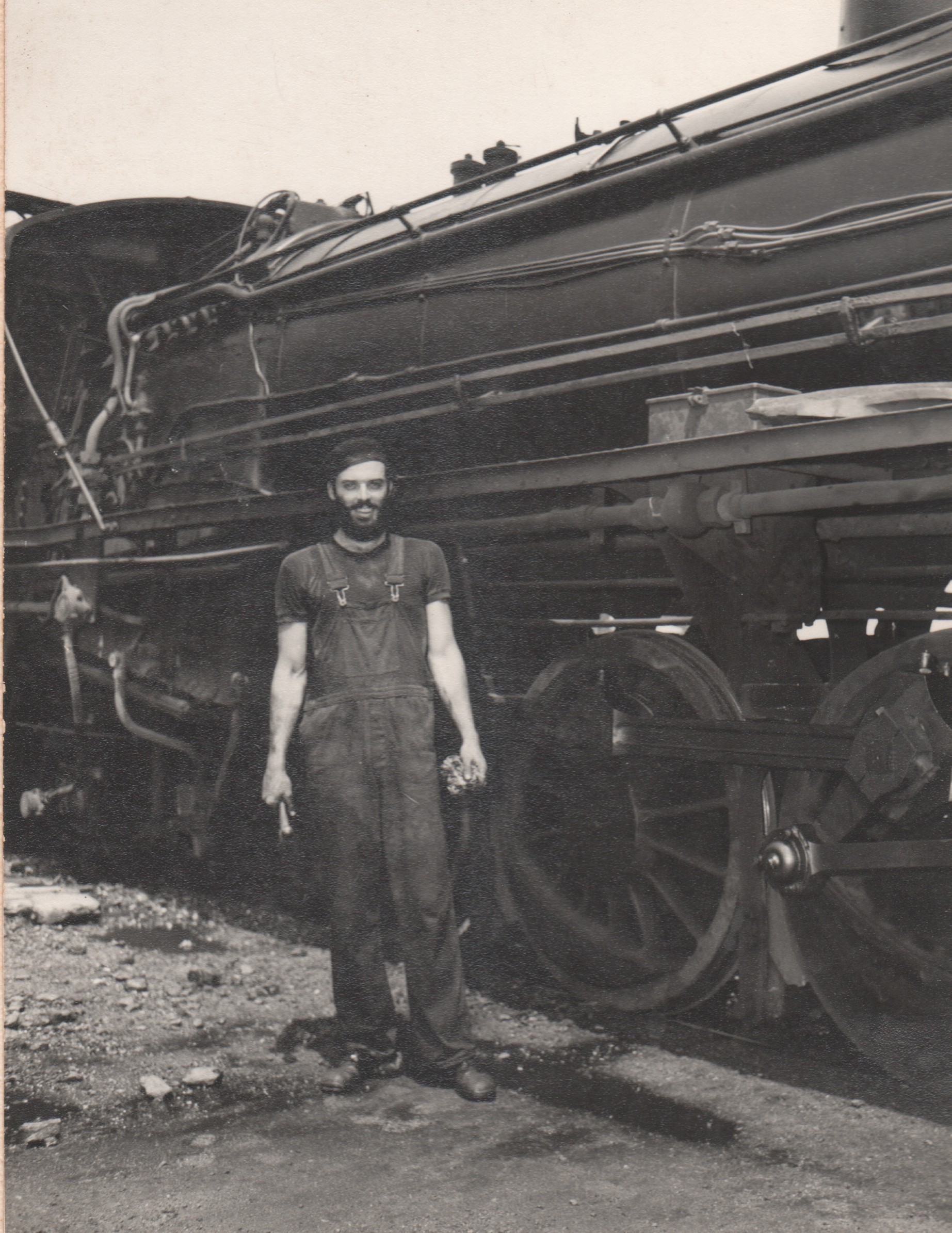
 I am pictured standing next to a “Dolly” (Class 19D) steam locomotive. That class of locomotive had a reputation for being easy to fire—good steamers. They laid down a solid, legato beat, and the exhaust tone could at times come across like toned percussion. Once up to speed, they would steam happily with five occasional shovels of coal aimed like so: a full shovel at the left and right back corners of the firebox, a not-too-full shovel of coal down the left and right sides, and a light shovel, twisted with a wrist-flick and sprayed down the middle. A quick check up ahead at the chimney stack would reveal perfect, lightweight beats of smoke.
The old footplate adage “fire light and often” was very easy in a Dolly. The beat—a dapper, tom-tom “daddle-daddle-daddle” at cruise—was an excellent soundscape when there was time (think ’long downhill’) to view the great Zululand scenery. On a Dolly, unlike with the larger Garratts, we could catch our breath.
Empangeni Rail
“Ag man, jy faait soos ’n meid.”
Arriving for my first shift at the Loco Sheds, I was ill-prepared for the scene: two men rolling in the dust, wrestling, hugging, puffing. It was brief. They were both spent almost before they hit the dirt. One was driver Botes, at least 150 kg, the other a burly enough man of perhaps fifty years of age. The quaint sentence above was uttered by Botes, who was in far more stressed fatigue than his older opponent. Botes was notoriously opinionated and rubbed many people up the wrong way. He probably started the conflict.
There was, however, an engine to prepare, and I could not remain with the knot of watchers, so I never found out anything further about this ouman tiff. In fairness to Botes, he was not old, but so overweight that most people thought he had days to live. How he coped with climbing up into, and even fitting through the door of, the cabin of a Class GE or GEA Garratt locomotive was something to see. He did carry his weight with something of a swagger, so it is safe to assume that there was a powerful body hiding in all that adipose tissue.
He was an infamous curser. So carelessly did he dispense the F-word that one of his sentences gained some traction in Cambridge Poly (used by Graham Pechey as an example of total abuse). Just so you know, the alliterative masterpiece was:
“F-ckthisf-ckingthingisf-ckinwellf-ckinf-cked.”
‘This thing’ was a gauge glass on the boiler plate. You don’t leave the loco with a damaged gauge glass: it is one of two that reveal the level of water in the boiler. If the crack in the glass tube had given way, we could have died in a cloud of steam. Another engine was found, and off we went, hours late, to Botes’s satisfaction. He was an ‘overtime king’.
Sugar Junction
Empangeni satisfied the other “junction” criterion in my quest for overtime. It had its own sugar mill a few kilometres from Empangeni Rail. There was a branch line to Nkwalini to the west, and there was a busy sugar mill line on that branch line too—a 24-hour destination for the endless cane trains from in and around Empangeni. In the Durban direction, not far away, was Felixton, where another mill kept trainloads of sugar cane coming, also night and day.
A consequence of the mills was “wayside” trains, where a locomotive set out with a load and returned, visiting every siding on the return leg where truckloads of cane or timber had been loaded by farmers along the route. The upshot of all of this was that working in Empangeni would almost certainly mean that I would get out of the shunting yards onto the mainlines, making it more attractive to me than Pietermaritzburg.
After training, when we were mustered for the various depots, plan A was Empangeni, plan B was Pietermaritzburg, and plan C was “grab what you can”. The northern Natal coalfields (Glencoe, Dannhauser) came in for a lot of mentions from my footplate staff informers, but the consensus was “not enough overtime”, and none of the footplate-men I spoke to enjoyed living in those areas. Empangeni was near the beach, and I found that engine drivers, almost to the last one, had boats in their driveways. Most were keen fishermen, some just keen on boating in their leisure time.
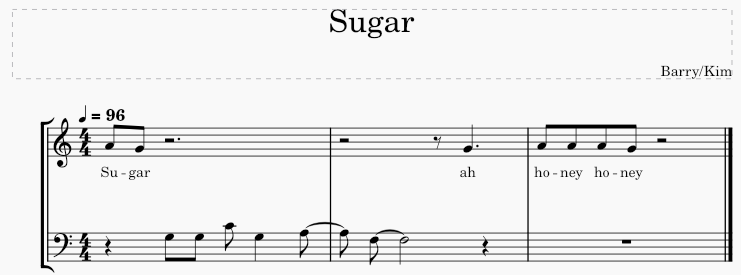
All the talk of junctions possessed my mind with an endless background song, naturally Glenn Miller’s “Tuxedo Junction”. My favourite version became that by The Big 18. It had the most satisfying ‘big treatment’ with an unusually great lineup of the most compelling mainstream jazz stylists of the time, not least a phalanx of great trumpeters including Buck Clayton, Rex Stewart, Charlie Shavers, and Billy Butterfield. I had grown up listening to all these legends in the Holy Tabernacle of Mainstream Jazz, and could (and normally still can) identify each and every one of them within a few bars of their playing (thanks to the glorious tradition of ‘blindfold tests’1
I don’t mean to knock the Glenn Miller version. However, Miller preferred to be thought of as a successful businessman. For example, he originally wanted to entitle his memoir something like “How I Made $850 Thousand From Music”. Some wily publisher surely talked him out of that. Anyway, without knocking them either, his sidemen reflected that. Putting it another way, even though he could afford them, he wouldn’t have chosen to pay for the likes of the musicians comprising The Big 18. Their trombone section on “Tuxedo Junction” was evocative and atmospheric, and for me represents the music of the “Steam Age” at its finest.
During shunting shifts (Dollies were seldom used on shunts), there was a six-hour shunting curfew between 22:00 and 04:00 to give villagers a chance to sleep. Shunting is hectically noisy, not only from locomotive beats and blasts, but also dynamite-like gongs as goods wagons cannoned into one another. Shunting engines typically had small wheels (for greater traction) and a harsh, explosive beat. We would accelerate, push a line of trucks, brake hard, release them, and watch the trucks silently roll down to the destined track (shunters would wait and switch points accordingly) to end with a crash of buffers that would awaken ghosts. Few people could sleep through that, even from far away. Sounds carry in the night air. Hence the shunting curfew.
Tragedy
I worked with a series of drivers on arrival, for about two weeks. Everyone wants an easy life, so no drivers saw me and kept me, until “Kaspaas” Carstens, a wily old overtime king, who decided I was decent and a good learner, and said so. He became my regular driver for some months. Roster clerks who assign jobs also want an easy life, thus finding it easier to send out crew pairs, rather than needing to look around for who was available. Once Carstens gave the nod, I was “his” fireman, for some months.
Carstens spoke fondly about his previous fireman, but also sadly. I assumed the lad had been transferred or had relocated: young people usually are scouting for something better, after all, and can be quite nomadic for a while, but that was not it. In episodes it was revealed that his fireman sometimes took a rifle on trips. He liked to shoot a buck for the pot. The bushveld terrain near Golela was impala country. There was a section between Candover and Golela that was not good track: it was not laid on ballast, but flat on earth, so the speed limit there was 15 mph. Anything faster, especially on rainy days, would have softened the earth, turning it to soft mud, and splayed the rails apart: speeding was a derailment waiting to happen. That slowness was also what influenced the youngster to go to the front of the locomotive, perching on the buffer below the smokebox.
I am unsure whether he ever got to shooting a buck. You may wonder why Carstens did not stop to give him a better shot. Well, it was private farming land. That meant that impala were the property of the farmer, so both driver and fireman wanted things to look as normal as possible: not many onlookers would expect to see someone hunting from the buffer bar of a locomotive. In the event, the youngster lost his footing, fell, and his dungaree strap caught on the shunter’s pole, swinging him out and back toward the engine, and straight into the valve gear and connecting rods. Nobody could survive that.
Naturally, for some time, I wondered what was in store for me: I knew so little. What had I got myself into? Would I survive the job? It was a sombre beginning.
Bokhok
Shunt shifts in Empangeni were generally from 06:00 to 15:00, and 18:00 to 06:00, but there was a long break in the night shift. Shunting even without steam locomotives is very noisy, with colliding knuckles of goods wagons ringing into the night: Some impacts between goods wagons were as loud as howitzers. To give Emangeni Rail villagers and Empangeni townspeople a chance to sleep, shunting was banned for six hours from 22:00 to 04:00. During the shunting curfews, we would retire to the bokhok 2, a small corrugated iron shed about 2m square floor area. It did not have a floor. There are some things the railways didn’t spend on, and this was one of them: I can imagine an accountant in Pretoria saying “What, a building for them to sit in? The can sit in their locomotives - nice and warm”. What that accountant would never know is that shunters do not have locomotive cabins to sit in. S/he would also never know that there were bye-laws against shunting between 22:00 and 04:00. Usually, drivers left stokers to see to the locomotive’s fire and water, and headed for the little shelter.
As for keeping warm, that was something we did not need in sub-tropical Empangeni. In the entire time I lived there, I never once wore a jersey. A tunic was supplied with the standard issue dungarees (the best dungarees I ever had), but I seldom used it. There was always a fire in the bokhok centre between a few bricks or stones on bare earth. We would brew coffee or tea and sometimes braai some meat. For the rest, it was storytelling time. Very naive for my age, I was taken in by the stories for a while. But when driver Jan told his hunting story, the trouble was that I’d heard the exact same story before my teens while on holiday on a Karoo farm, told in the first person by someone completely different.
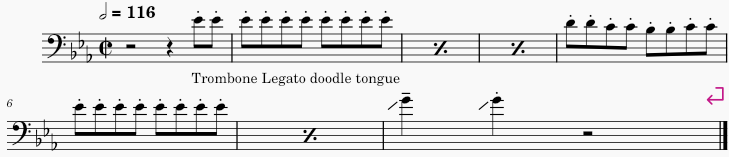
The bokhok was our theatre: no limelight, just the dull glow of coals in the little Khoisan hearth, or sometimes a paraffin flicker, but the lighting was somehow dramatic: faces were lit from below in the best horror movie tradition, and we all got a chance to strutt our stuff. We developed fair skills in imitating certain locomotives. Some made a unique sound through the chimney stack, connecting rods, or pistons—easy to imitate, and easy for us to identify. I became pretty good at imitating the sound of a Dolly: no particular one, just the class in general. It was a cross between hissing and saying “daddle-daddle-daddle”. I had to get good at it for my stories to go down acceptably. That same “daddle-daddle-daddle” served me well two decades later when I started on trombone. I didn’t know it, but imitating a 19 Dolly gave me the perfect jazz doodle tongue to perform that legato doodle tonguing at 3'22 in the 1988 African Jazz Pioneers album version of Hellfire:
Oom Schalks
It was at its worst dismal, but at best, not unlike renditions of HC Bosman’s Oom Schalk Lourens. Sometimes I had to blink to make sure it was not the Boy From Bethulie on stage. One-man shows of Oom Schalk have become a South African thespian tradition, with David Butler and later David Muller following in it.
In the bokhok, everyone took a turn at his own thing. For example, one night, Oom Jan had a go.
“I went big game hunting one holiday,”.
Bok leaned over from his tree stump seat, dug me in the upper arm, and hissed, “He’s never been big game hunting.”
“It was far in the West Transvaal,” Oom Jan continued. “Making our way carefully through the bosveld, we came upon a large clearing. On the far side of this molapo stood a reuse groot olifant. We froze. After some time, we realised he had spotted us, was actually looking right at us, but he don’t charge us. Just stood still, there. Why don’t he charge?”
Oom Jan knocked his pipe against his tree-trunk seat and patted his pockets, looking for his twak.
“Why don’t he charge?” he asked again. We waited. The pipe was parted, the stem blown through, then refitted to the bowl.
“Well,” continued Oom Jan, “it was not easy to understand. But with my powers of observation, I felt I had found the answer. He was not standing on all four feet. One front foot was angled. Aha! I thought: Hy’t ’n groot doring in sy poot. He has a thorn in his foot. Well, as you all know, I can’t resist doing a favour. I walked up to this huge bull, bent down, and reached underneath, feeling for the thorn. But it was difficult. The foot was partly still on the dry, baked earth. I thought, what can I do now? Then, I got it. En toe, kielie ek sy poot. I then tickled him under-foot. He lifted the foot quickly, I got my hand underneath, and pulled out a gigantic thorn. The elephant replaced his foot flat on the ground and slowly slid away into the bush.”
Oom Jan looked at us all. We said nothing.
“Ah, I know. You think, I was hunting, why didn’t I shoot myself a record-sized bull elephant? I could have shot him. But I didn’t. After all, I am a good sport, as you all know.”
He patted his pockets, searched again for twak3, and continued once the blue plumes were rising from the pipe again.
“That was not the end of it,” he said. “Years later, my wife and I went to Boswell-Wilkie Circus. Jong, the clowns were funny. Then, the elephant act entered the ring. A reuse groot olifant came over to us, put his trunk around both my wife and me, lifted us out of the five-shilling seats, and put us down in the fifteen-shilling seats. It was that same elephant.”
The End of the Line
I did a little less than a year in Empangeni. While there, I averaged a work rate of 550 hours per month. Work it out for yourself. The norm is 40 hours per week, so you can see that I did not have time for much else than work.
It was fearsomely tiring working on the footplate. The tenders of most engines took ten tons of coal, and we (especially on the Garratt double engines) often replenished coal at the end of a four-hour run. If you don’t know what that means, picture it this way: a ton of coal is more or less a cubic metre of coal. I am 1.78m tall. Da Vinci’s drawings show half our height at crotch height, so a cubic metre of coal would come up to about my solar plexus.
To put this in perspective, as a kid my parents would order a ton of coal for all of winter, dumped in our coal cellar in the form of 22 sacks. They weighed one hundredweight each in the old measurement. So, I routinely shoveled away ten times what we used to heat the whole house for a winter or two, every day. Pile 220 sacks of coal into a heap on your back lawn and shovel that pile into another pile next to it: you won’t need to spend any money on a gym.
The Stoker Challenge
We depleted our 10 tons on a class GEA in the 100 or so kilometyres from Empangeni to Stanger. Excluding the two tons we needed to bank up our starting fire with, that meant swinging a shovel, laden with 18 Kg (40 lbs) of coal, every 32 to 48 seconds. In the gym, try to lift 9Kg every 32 to 48 seconds, but with a catch: do it bent from the waist, to match a low firefole door close to the foot plate.
Do that for four hours without a break. Congratulations! You are as tough as an Empangeni fireman. Feel the burn in your lower back! For motivation, imagine a cheerful guy with a few extra kilograms on his body, smirking and saying:
“Kan dit nie vat nie!”
A year after Empangeni, I would wake up in a bed-sit in Earls Court Rd, West Kensington, in a cold sweat, dreaming I was lying on a mound of coal that would be chest-deep in that bed-sit, if the coal from the average steam locomotive were dropped into it, and that I needed to shovel the coal aside to get to the door, and then the toilet, and my bladder was bursting. Just like on a GEA. Eish!
Global warming causes whole fields of crops and houses in England to catch alight at around 41 °C. The ambient temperature in a steam locomotive cabin on any Zululand day was around 50 °C, and way more on a hot day—about the only kind of day Empangeni gets.
Saving for Rainy England
I asked my younger sister to take charge of my savings and sent her my entire pay packet most months. My target, after doing some calculations on the price of a voyage to England, was R1,500. I had reached a little less than that when, one day, I realised that I needed a break. It came about around the issue of “rest”.
“Rest” was a loaded word in the loco sheds. You could “claim rest”. It came in increments of even-sized duration: two, four, six, eight, or twelve hours of rest. The problem was they blacklisted you as “No to Overtime”. People were on/off like transistors: they were “yes” or “no” to overtime. Claiming rest meant “no”. If you claimed rest, you labelled yourself forever. The roster clerk was a powerful man, and he would decide one of two things if you claimed rest:
- You were lazy
- You couldn’t take it
Of these, “can’t take it” was the worse. At least “lazy” meant you could cope, but didn’t want to. “Kan dit nie vat nie” (can’t take it) was a final and damning judgment, resulting in one never doing overtime ever again.
Overtime was the sole reason I chose to be at Empangeni in the first place, so this outcome could not be risked. The roster clerk was fairly overworked, and would instantly assign the overtime to someone else and not bother with me any further.
When I decided, near the end of that year, that I had had enough, two things decided it for me. The first was that I got a massive fever and diarrhoea one night, and went to the doctor that morning. He diagnosed gastroenteritis or dysentery—I forget which, because it made no difference. By the time I consulted him, I was exhausted, hollowed out, and empty from evacuating my stomach contents all through the night. But this hypocritical Hippocratic oath failure went immediately on a rant saying I was “skiving off work”, and sent me back to work with two pills to stop my loose stomach in its tracks.
What followed was one of the hardest days of my life. Contrary to the doctor’s position, my driver for that day was very protective and caring, putting on a lot of coal for me when I collapsed onto the footplate. He was truly alarmed and had little good to say about “that blerrie quack. There were plenty of those zealots around: slaves to a system who really could not see anything wrong with their crass inhumanity.
They were supported by a system reinforcing this kind of work ethic. For example, you were paid overtime for every hour worked over and above a total of 224 hours per month. Saturday was rated at “time and a third” and Sunday was “double time”. There was, however, a catch. No doubt this ‘catch’ was conceived by Oom Ben Schoeman, Minister of Transport, who had himself been a stoker for some months. He would have learned what a tribe of inveterate schemers steam engine drivers could be, and this was how to put a stop to it.
I think he had to: footplate-men, the arch-verneukers of this world, began to work (they may have shared some money with the roster clerk to do this) on Saturdays and Sundays only. That way, for two days, they got three and a half days of work per week, leaving the weekdays to “go fishing”, as my driver put it to me. Forbidding the paying of overtime unless you worked an aggregate of 224 hours per month was exactly the sort of Calvinist strategy those churchy “devil has work for idle hands” types were deft at coming up with. No wonder the railways could neither keep nor recruit enough footplate staff. Good strategy, poor vision.
Unsurprisingly, the fatigue alone was enough to make me want to call it quits. However, something else made me realise I was in a far worse state than I had thought. When it reached the point where I was so weak and tired after the gastro attack that I could not face even an eight-hour shunt shift, I went to Andries, the roster clerk, and asked for a word. I told him about being sick and about the doctor. He was not surprised.
“Ja, man, that doctor! I know him like that.”
I explained that I was not going to claim rest again if I could just regain some strength. I needed and wanted overtime, and would return to making his life easier by “never saying no” again, but I really needed this rest. He agreed, granted the twelve hours rest, and I trooped back to my room in the hostel, safely sure that I would have a good long sleep. I fell asleep immediately as I slid under the sheets.
Spinning Wheel
At the end of the song of this name, the band Blood, Sweat and Tears, breaks into 3/4 time and sings:
Beware of the naked man.
I was to be reminded of that phrase many times in later years.
The next morning, I walked to work as usual. It never occurred to me to figure out how long I had actually been off—though it should have. Now, everything was strange. The road to the loco sheds was flanked on either side by railway dwellings. Usually, I would raise a hand in greeting to people in their backyards, but this particular morning was weird. Housewives chatting across their backyard fences cackled or giggled and ran inside. One even raised her hands in the gesture fishermen use to show the size of their catch. Too strange for words.
When I reached the shed, a call-boy on his way out saw me and fled. Two others, footplate staff, ran and hid inside. When I reached Andries, the roster clerk, he was stooped, head below desk level, and when he rose again and saw me, he ducked and flinched.
“What’s going on, Andries?” I asked, when he had braced himself.
He studied my face for a while. It was a long while. Then, “Do you remember coming here yesterday?” he asked.
“Of course I remember being here yesterday—I claimed 12 hours rest yesterday.”
“No. That,” he said, looking cautiously at me, “was the day before yesterday.”
I looked outside into the bright morning, beginning to feel uncomfortable. If I had slept only 12 hours, I would have been here at a different time of day. What was going on?
“You sleep naked, right?”
I looked back at Andries. “What?”
“Now, how do I know that? Think about it.” Well, he had never been to the room in the house I slept in as part of the hostel. I was sure of that.
“I have no idea. Yes, I don’t have pyjamas.” I had not had any since school days. “How do you know that?”
“So,” again he paused, “you… don’t remember being here yesterday?”
I shrugged. He flinched even as I shrugged. Hell, what was I, a monster all of a sudden? The other two footplate-men who had fled inside when I arrived now dodged past us and scrammed outside, watching me warily.
“OK. It was my fault.” Andries shifted uncomfortably. “I completely forgot that you had claimed rest, and I sent a call-boy to wake you up about two hours after you had claimed rest. It was a mistake. I am sorry.”
“So what? What does that have to do with yesterday?” I was really impatient now.
“The call-boy says you jumped out of bed and chased him all the way here, and you wanted to bliksem him.”
Unbelievable. I looked at him. He did not come across as a guy pulling a prank on me; in fact, he still looked very wary.
“That’s why everyone is avoiding you today. You came here, furious, chasing the call-boy. And you were stark naked.” He nearly ducked as he said it. I was so astonished I must have spooked him.
“Stark naked? What?”
“Yes. Sorry. I am not making this up. Like I said, how do I know you sleep naked? You chased the call-boy all the way here, four blocks through the village, early in the morning, stark naked, angry as hell because he had woken you. It was my fault. He was terrified. We were too. We didn’t know what to do. But then you walked home again, and we thought it better just to leave you. You must have slept all of yesterday and through the night.”
It took me a long time to swallow that. I was stunned. I sat on a bench for a while. Andries brought me some tea. I apologised.
“Really? I did all that? Naked.”
He spread his hands, speechless. “Luckily, the kids were all on their way to school. Only the pikkies saw you.”
The tea was sweet. I hate tea, and I hate that much sugar, but I drank it very gratefully.
In time, I got up to negotiate my next shift. “I didn’t expect you and I have nothing for today. Maybe it is a good day just to rest up. I can give you a shunt shift tonight. Tomorrow, you can rejoin Roy again.”
“Does Roy know about this?” I did not want to lose my spot in his schedule. He was a really great guy and very good to me.
“Everyone. Everyone knows about this,” said Andries, suppressing a smile. “Just about everyone saw you anyway, and those that didn’t… well, it was the talk of the day.”
I trudged home. On the way, women were still covering their mouths and giggling at the sight of me. One, carefully looking around first to check she was unobserved, clenched her fist and bobbed her forearm up and down, raising her eyebrows twice in quick succession, then burst out laughing and ran inside. Another looked pointedly at my crotch area, hissed “mooi”, and also fled inside.
Back home in the cool of my room, I realised my time on the railways could not carry on much longer. If what I had been told was really true—and putting people’s actions both at the loco shed and on the way to and from it together, I could not doubt that it was—I was obviously tired beyond much further tolerance. I had, as my Mom would have said, gone at the whole overtime thing “like a bull at a gate”, and something had to give.
Things slowly reverted to normal. I was on shunts for maybe a week before I got back with my driver, Roy. Apart from Bok asking Oom Stefaans in the bokhok if he had any good nudist jokes, nothing further was said about my morning “run”—except by Roy himself, and he was dead serious.
“You need a woman, mate. You. Visibly.” (he flicked his eyes at my crotch) “Really. Need. A. Woman.”
He took some pains to discuss what, at school, we commonly regarded as Archimedes’ Theorem: “The angle of the dangle stands in direct proportion to the heat of the meat.”
He motioned with his forearm, as that backyard lady had done, in a way that illustrated the school theorem at an upward trajectory that proved, for him, that I “Really. Needed. A. Woman”. He said he had an address in Durban he could send me to (he was long divorced, so I guess he knew what was what).
“Ten Rand for a short time,” he said.
I was OK about his wish to help. He felt he was doing the right thing by me, but it made me giggle. He took that as shyness. “It’s OK, they know how. They do it all for you. They will sort you out,” he said.
I worked for perhaps two months at most and then spoke to Andries. He explained how to go about resigning. On the first of December, I handed in my resignation. It was silently accepted. No eye contact. I felt a whiff of my long-standing fear—of the memory of Digby McLauren, of the “men in white” coming for me.
It turned out I needed only two weeks’ notice, revealed by the office sending me a concession covering my tickets home to Pietermaritzburg. They were dated the 15th of the month. I have a mental block regarding everything to do with my time in Empangeni coming to an end, but I think I took the day train to Durban and then the Trans-Natal in the evening. That would have dropped me in Pietermaritzburg just after 8:00 PM. I suppose I must have taken a taxi to the flat shared by my mother and sister in Loop Street.
I did not develop an affection for Empangeni, even though I lived there for close to a year. To come to love a town or a village, one has to explore, to walk, to sit in parks. To this day, I have little idea how the commercial centre of Empangeni looked back then. It is warm or hot in Empangeni, seldom cool or cold. I must have walked to the town centre to the barber perhaps four times in my stay in the rail village. Always shy, I never even learned the name of the man who cut my hair. It was rather formal and polite, and I remember only that walks to and from town were a very sweaty endeavour, not looked forward to and avoided until my hair grew really shaggy.
On my arrival, I had located the bank and a barber. I thought those were all I needed, but I was wrong: I needed only the barber. I never used the bank. There was a post office in the rail village, and I sent money from there to my sister Irene in Pietermaritzburg, where she banked it in my building society savings account.
To England
There was enough in savings for the return ticket to England, and more. My sister Irene (“Zim” to our family) had looked after my money for me perfectly. It would have been quite easy for her to do, because she was working in the building society where I held the account. I like to mention it, though, because she was a rock I could rely on—a huge comfort in a difficult time. Empangeni had always been part of a long-term strategy to get me out of SA before I did something unwise. Or before the men in white came for me.
Pietermaritzburg does not empty at Christmas time as much as Johannesburg does, but a lot of people head for the coast. I was at a loose end and wandered around a lot. Some days I visited friends. They were fascinated and horrified at my callouses, cracked and coal-stained as they were on the finger pads of both hands. Shovel-hardened. Some were interested in what my stoker’s life had been like; some had no interest, and a couple of them thought it was infra dig, disdained even discussing it, and were glad I was out of it.
Just before Christmas, I decided to buy some presents with my hard-earned cash and spent a full morning going from shop to shop. I took all the purchases home and returned to town for lunch, unable to decide what to eat. There were lots of choices. The pub grub at the Imperial Hotel was good (my favourite there was curry); then, The Creamery used to serve a pie and gravy—another favourite. I think I settled for The Creamery.
Then, deciding very suddenly, I went to a travel agent to book my voyage to England. Feeling pretty happy with things, I came out of the travel agent walking on air. Liberation from apartheid was in sight!
Down Church Street, on the pavement outside Shuter & Shooter booksellers, I met Jeff Guy. I knew he was working at the archives near Market Square during the university vacation.
“What are you doing?” he asked. It must have been my expression: he sensed something had happened. “I have just booked my passage to England.” He stared at me for a long time. I could see his thoughts were racing. After a long pause, both of us holding up the milling gift shoppers, he blurted, “Can I come with you?”
We embarked in Durban on 17 February 1967. The vessel was the Southern Cross, plying to England from New Zealand via Australia and South Africa.
I don’t remember Jeff’s cabin. I shared mine with three others. They were all old, and two were very sickly, smoking all day on deck and coughing all night, every night, in our cabin. The healthy one was friendly and sat with me at times whenever he found me on deck. He was English, from Hampshire I think, and was sad. His partner had predeceased him years before. She had always controlled their money, and without her he struggled financially.
Some years before, a friend and contemporary advised him to sell his property, invest the money, and escape both winter and his various hardships by taking trips on cruise liners. It worked for him. All told, life on the ship was cheaper than life on land. He enjoyed not having to cook for himself (I found the cuisine on the ship was like really good hotel food) and had always been a good sailor, so the occasional passages through high seas did not bother him. Toward the end of the trip, he added, “And if I snuff it, they will bury me at sea, no charge.”
There is no way now that I can verify this, but he was firm about it. He had one living relative to whom he had bequeathed everything he owned, and “there’s no point in spending a lot of money on mournful old buggers with top hats and on grave diggers. Bugger that.”
Strange old man. There was a burial at sea of an old man on the ship, not anyone I knew. Unable to sleep and walking the deck at first light, I was in time to see what I found out later from the Master-at-arms was a “body in a sheet”—though it looked more like a white shroud—sliding down a chute, overboard and into the cold grey-green waters of the Atlantic, a drop of perhaps fifteen metres. I had never thought about disposing of our dearly departed on a ship, simply assuming that such ships had a means to preserve a body until a final destination port.
Through the years, many people have told me that what I saw was something else, not a burial. They may be correct, but I can’t unsee what I saw. What else, the size of a body, would a ship put on a tilting chute and consign to the deep, with people standing to attention, appearing to mark respect? Maybe the Master-at-arms was having me on, but he was a rare example of a totally humourless Irishman, a barrel-chested ex-British Army sergeant-major, apparently intent on being more English than the English. I think he detested his own accent.
Some way into the voyage between Cape Town and the equator, I got talking with a slender and pale man, a few years older than me, with a slight American accent, who explained that he was from Cape Town. The accent (it was slight, and he was surprised I picked it up) was from studying at the Manhattan School of Music for some years. He was travelling with his young wife and their infant, and looked permanently harried. Later, I realised that this little family of three were absolutely not good sailors. I myself was queasy the whole trip, though it never developed into full seasickness.
Nowadays, I know the queasiness was not because of the motion of the vessel, but because of the size of the step I had taken. From the time I had decided to leave, I was sick with misgiving. It is impossible to put into words what it is like to be so physically, mentally, and spiritually sure-footed in a country, and then choose exile to a place where the sun arcs through the sky at the opposite angle to that I had grown up with. I still think it was the right thing to do. The frustration of living under apartheid would have driven me to do something completely unwise and stupid. I had always been a hothead, with the shortest fuse and the foulest of tempers growing up. It took decades of hard knocks to learn to cool down.
Jeff joined the music student and me one day as we sat chatting. Jeff was a long-time Beethoven fan. Eager to impress the student, he mentioned the “unusual D-flat on the double basses in the second movement of Beethoven’s Ninth”. I probably have it wrong, but it was something like that. The student closed his eyes, thought for a moment, and then said, “There’s nothing unusual about that note. It’s an ordinary dominant seventh.” Jeff blushed. Later, in the ship’s pub, he laughed at himself sheepishly, saying, “Saw my arse back there. I will never again believe, nor quote from, an album’s liner notes.”
Liquor was incredibly cheap on the ship, plus they poured a tot size that South Africans regarded as standard—a bigger tot than we found in English pubs. The price for a single whisky was 13 pennies, or (in those days) “one-and-a-penny”—one shilling and one penny. The beer was new to Jeff and me. To us, some of it was like watered-down lager, but the Australian lagers suited us. Sadly, they ran out of it before we reached England.
I liked spending time at the pub, not only because a few drinks helped me sleep through the nightly racking coughing in our cabin, but also because it was good to meet other people. They were mostly from New Zealand and Australia. Their girls were very different from the white South African girls. I can’t forget discussing this with my brother Al, and his unique turn of phrase:
“South African girls have a very sceptred idea of their value in the market place.”
It has changed a lot, but seemed depressingly true back then. I made friends on board with two Cape Town girls who were regarded in those days as “Cape Coloureds”. They were both gracious and had no airs. One was a dancer, the other a secretary, and they both separately confided they had as much apartheid as they could stomach and intended to try their luck elsewhere. Both of them were attractive and fun. We did not trade postal addresses—I tried with one of them, the dancer, but it didn’t seem her thing. Her name was Philida. She was long-limbed, gamine, fit, freckled, beautiful, graceful. We did not talk a lot, or often even, but I can’t forget something she said. It was neither pointedly judgemental nor directed at me. She was just being frank. I think someone in our group asked about a white boyfriend—had she one, or had she had one, whatever. She replied seriously:
“You have to be really careful with whites.”
So, no wonder I was not going to get that contact address. I wouldn’t be very trusting if I had been subjected to what she and her people had contended with all their lives. I did not know Cape Town, but there was not much apartheid around in Pietermaritzburg while I was a toddler. We had seen how the Group Areas Act removed coloured people who lived in our area. It seems a strange observation, but as the few coloured families we knew quietly disappeared off our map, so all colour, in other ways, went out of our area and out of our lives too.
The ship, large as it was, felt claustrophobic, and I spent a lot of time walking and running on deck. It cooled only when we were within days of England, and I enjoyed my night walks on deck a lot. Some nights, looking down into the waters the vessel was driving its way through, there were the magic lights of phosphorescence illuminating the crests. I gazed at it for hours. There is nothing on land like that, unless one counts fireflies and glow-worms. I never once spotted a whale, something I had hoped to do, but the flying fish were incredible. Shoals of them would breach and skim the waves, and I never tired of watching them.
One night I found the tough Master-at-arms in a favourite triangular-shaped place in the bow. He was taking a breather, I suppose, but we got talking and did so for hours until duty called him. I realised he was actually shy, not really a people person at all, and valued that he opened up to me. We saw out the voyage on good terms, and he waved goodbye very cheerily as he passed by on the quay in Southampton.
About landing at Southampton: I woke early and went on deck, and was, for whatever reason, moved to tears as we approached landfall. Was it relief after seventeen days at sea? As the emotions flowed, I realised it was a kind of phantom homecoming. We were brought up as English, and at this moment, England suddenly felt like the “Home” the characters in books always spoke of.
The ship had eased off cruising speed, and we moved cautiously down a channel the Master-at-arms told me was called The Solent—a channel he said was about eighteen miles from open sea to Southampton docks. I don’t think it was that long, because it took about two hours at a speed I judged less than 9 mph, but I don’t really know. It felt endless to me in my excitement.
Jeff was going straight to London. I was not. My immediate destination was Bristol. I needed to see my best friend from a few years before. I don’t remember much about finding the train station—it may have been right there close to the docks. With amazing good fortune, though, I found myself booked on the last-ever mainline train pulled by steam from Southampton to Bristol.
What a find for a steam buff like me! I had time before departure to chat with the fireman on the green (Southern Railway) locomotive—to my eyes, a streamlined and fleet-looking engine—so I was foully disgusted to hear someone on the train describe it as a “spam can”. It had the usual (for England) large-diameter driving wheels, six feet or so in diameter. It looked to me as graceful and sleek as a racehorse. These days, from what I found online, it was one the Bulleid design, with front panels shrouding the smoke box, known as the “Battle of Britain” class, or the “Merchant Navy” class, with driving wheels six feet and two inches in diameter. The fireman, when I chatted to him, called it a “spam-can”.
It drove me wild with excitement picking up speed after clearing the commuter lines. South African Railways locomotives were mostly built for pulling goods from the ports to the Reef through mountainous country, and only one locomotive back home had six-foot driving wheels: the Class 16E. Although I had been on trains pulled by it, I was not expecting the speed we cruised at in England. Seventy miles per hour plus seemed nothing to this train, but of course it was designed for those speeds, and my panic levels soon changed to enjoyment at the brilliant green scenery whizzing by. Bristol, John Lloyd, and Three “Birds”
I made my way from Bristol Temple Meads by bus to Clifton Square, where John Lloyd was gobsmacked to find me at his front door. I had not let him know that I was coming, not wanting any Special Branch people who might open my mail to catch wind of that plan. He consulted his flatmate, and I was told I could stay for a few days. The flatmate was not that pleased.
On that first night, John said, “Let’s go and meet some birds at a pub.” The “three birds” turned out to be Barbara Schumacher, Sandy Kelsall, and Rachel McGavin. It was a happy evening, and my first in an English pub. All three girls were at Bristol University. All three were brunette, though Sandy was a bottle blonde at the time. I spent some weeks in Bristol, and then headed for London after overstaying John’s flatmate’s welcome.
The time with John was fascinating in terms of what he was doing. He was a teacher and involved in some experiments new to the education system there. Comprehensive schools were fairly non-conformist, and John found he had a lot of freedom in curricula and in terms of his teaching modus operandi. We never got around to talking about his exit from SA, after an approach from me which faltered from the outset. It was too heavy a memory for either of us to yet handle satisfactorily.
Given that one of my chief aims was to understand from John what and how things went down regarding Hugh Lewin doing seven long years in jail—something that many people squarely blamed Lloyd for—I remain unhappy to this day that we never got to talk about it all. The whole African Resistance Movement (ARM) history is well covered by various people who have written books about it. Understandably, they were, to the last of them, very angry with Lloyd, so I was doubly keen to get his own insights. Sadly, it was just too hard for him at the time.
I need to express the sadness more fully. John Lloyd was brilliant and always good to me. I was a few years younger, and it was thus perhaps an unusual friendship. In England, as a teacher, I found that he was gifted, very modern in approach, and that he had the same keenness and dedication to youngsters as was probably the cause for the time he put into a younger guy like me. He was five years older than me and probably a sort of replacement for my absent brother, then living in Grahamstown. I was a student, whereas he was already out of university and working on newspapers.
Things had started out, as they did with so many of our friends, with John visiting my brother in “The Holy Tabernacle of Mainstream Jazz”—brother Al’s room at our St Patricks Road house—and eventually becoming a supper guest, along with Cathy Shallis 4 and Caroline White 5.
There were many others at the table with us over the St Patricks Road years, almost all university connections, including Maeder Osler—on whose newspaper I worked very occasionally in the ’80s, and on whose farm I was lucky, due to his and Leslie Osler’s generosity, to stay for two years 6—Graham Pechey, and Jim McClure.
They and many others would move up from ‘The Tabernacle’ for supper. There were some wonderful debating tussles between my dad and various students and academics, most of them ending in my dad shouting:
“DON’T ARGUE WITH ME: I HAVE MADE A STUDY OF IT!”
It was a classically successful conversation stopper. My dad had a fragile ego and thus little time for university people, especially when they bested him in an argument. He needed to be the Final Authority On All Things in front of his family, and being questioned did not suit him at all.
How my mom managed to cater on the fly for extra people was something I did not question at the time, but when I asked her many years later, she said there was always too much food anyway. Why was there too much food? I think she asked the domestic worker to put food on the stove while she was still at work, and the domestic, as a chef, had a heavy hand! Hugh and Liz Lewin were frequent visitors to our Scottsville home, both in the Liberal Party at the time, and John could have met them through that.
John and Hugh were eventually to leave Pietermaritzburg and take up journalist posts in Johannesburg. They may have started on the Rand Daily Mail, then edited by Laurence Gandar, but moved after a time to Post, a newspaper targeting an African readership. It had previously been the Golden City Post. The Rand Daily Mail was the predecessor of the Weekly Mail (later renamed Mail & Guardian) and was the only newspaper at the time writing about issues affecting African people—though clearly not enough for the taste of Lewin and Lloyd, or they would not have left. It was while they were at Post that they got involved with the African Resistance Movement, a movement that espoused violence (though not the taking of human life) against the apartheid government.
I missed John and Hugh when they left for Joburg, so I would use my student vacations to hitchhike to Johannesburg and beyond, sometimes staying overnight with them. Looking back, it surprises me that there was always a bed at their flat in Hoofd Street, Braamfontein, and they always warmly welcomed me. I was dirt poor, phones were not much of a thing in SA back then (and certainly not part of my life), so it is kind of remarkable that they could accommodate me without any warning or notice that I was coming. But that was how they and most of us were!
The last time I hitchhiked to Johannesburg to see them was in July 1964. The news had come through in Pietermaritzburg that Hugh had been arrested, and I really needed to see John.
It was a fairly long walk from City Deep, where I was dropped, to Braamfontein. Hoofd Street itself was nearly the highest point in Braamfontein, so I was pretty warm by the time I turned down into Hoofd Street. Their flat was about where the crew entrance to the Civic Theatre is now. As I walked down the street, I picked up some disturbing sights. Just above their flat was a parked car in which a man sat motionless, and I quickly spotted a similar apparition further down the street, below the flat.
John and Hugh were clearly under surveillance. It was not all that surprising: all of us left-leaners had long developed a sixth sense warning us of these goons. I did not miss a beat and continued walking down Hoofd Street without looking at either the flat or the goons in the darkness of their cars.
Passing the second watcher, I crossed the road so as to get an excuse to look back up the hill, and noted that John and Hugh’s flat was in darkness. I had never arrived there before without the lights blazing until fairly late at night, and a horrible feeling soured the pit of my stomach. Continuing down the hill, I turned right and made my way down to Empire Road, then turned into Jan Smuts Avenue, aiming for Saxonwold. It was very cold, and I did not fancy walking the streets all night—which I often did in summer in the absence of somewhere to stay.
The intention was to knock on the door of the Seawright house, hoping that Carolyn would put me up for the night. It did not turn out well. By the time I got to their Lystanwold Rd home, it was sleeting. I had a sports blazer, but had walked all the way from Braamfontein, and was a little damp, and very cold. Waiting at the front door after locking several times, I saw Mr Seawright lift a fanlight from one of their bathrooms. Seeing me (I think thought I had not noticed him) he quietly closed the fanlight. I knocked and waited for a long while, then, desperately cold, I did something very stupid. I vaulted their wall into their back garden, skirted the house, and (I was that skinny) squeezed my way through the piano-wire burglar alarms in a little room, maybe a TV room, and let myself quietly into the house. As I rounded the steps toward Carolyn’s bedroom, a hand grabbed my head and pressed a revolver against one temple, with the whispered:
“I could kill you like a dog.”
It was Mr Seawright.
I waited. He didn’ shoot.
Strangely, he lowered the gun, and, with a smirk, sauntered up the passage, and pointed me to Carolyn’s room. There I found her lying, abject with terror. Well, that is the first and last time I ever abused anyone’s space in that way. I don’t blame Mr Seawright. He was that kind of person, and I knew that when I “came in from the cold”. I think I thoroughly deserved what I got.
What it most pointedly did was to convince me my time in SA was all washed up. Time to leave.
The Realities of the Footplate
Following the Second World War, and having lost a percentage of able bodied youth, the South African Railways planned automatic stokers to ease the physical burden on footplate crews. You can understand how footplate crew felt: while the engineers crowed about how wonderful it was to have two engines in one, pulling much more from the coast through mountains to the highveld, the stoker was feeding two engines instead of one. There was no such thing as an easy life for a stoker on a Garratt. However, while Garratts were generally configured from combining two light engines, the last of the reasonably small Garratts was the class GE. The GE was a pre-war, smaller beast. Unlike the spacious, modern cabs of later classes, the GE possessed a tiny, cramped, and notoriously hot footplate cabin. It was a rolling oven. I fired them a lot, but not much out on the mainline, mostly from the yard to the local Empangeni sugar mill.
I also fired, mostly out on the main line, class GEA Garratts, designed by Dr M.M. Loubser. They were explicitly drawn up to house mechanical stokers: what met the rails were two class 14 locomotives. The 14R was not the easiest class to fire in itself. It had a tiny, cramped cab. Stokers who fired them regularly had no hair on their forearms - it all burned off. Many had no eyelashes. There was no space to step away from the firehole door and cool off. They had small driving wheels, meant for climbing hills, not for galloping across the plains, and they were hungry for coal, made a lot of noise maxed out 75 kph, and they were thirsty too. Squat on the track, they also bucked and lurched more fiercely than most: most elbow and upper arm bruises I sported were thanks the stingy 14R cab and its sudden side steps.
Feeding two of them, as on the GEA, was a massive, stubby boiler, the first Garratt without a tall steam dome. Two tall water tenders, much taller than on any previous Garratt class, one in front, and one at the rear, supplied water. Their massive 51.3-square-foot grates were at the absolute limit of human endurance.
In much the same way as with a later Transnet Chief Engineer 7 a classic bureaucratic and procurement blunder took place: the stoker mechanisms were ordered separately from Beyer, Peacock & Company, and when they finally arrived in South Africa, they simply did not fit their parent GEA cabs. With money being tight after the war, and rather than re-engineer the fleet under tight post-war constraints, the SAR rejected the stokers entirely.
The GEA famously became the only post-war Garratt class to be entirely hand-fired—and one of the largest locomotives ever manually stoked in the southern hemisphere. It was so demanding on stokers that for some years, crewmen succeeded in getting them fired by two stokers instead of one. And that was exactly how footplate crew felt: they were working twice as hard for the same pay. They felt they should be paid double. That was never going to happen with accountants around, and even the concession allowing two stokers on the PMB-Franklin line was an admission of the problem, the two-stoker setup eventually fell away. We got neither double pay, nor any help. Nobody really cared.
The Chemistry of Northern Natal Coal
At Empangeni, we seldom had the luxury of receiving the high-quality, high-calorie Witbank coal, which left mainline crews covered in a greasy, oily black soot. Instead, our tenders were loaded almost exclusively from thirteen different collieries in Northern Natal—districts around Dundee, Vryheid, and Utrecht.This coal could be disappointing. It made “little head” and was heavily composed of low-grade, inert shaley material.
It never really made great steam, was a constant battle and it lacked the fierce heat units of the Transvaal seams, meaning you had to physically shovel a far greater volume of fuel just to maintain pressure against a heavy load. The ash bed built up with alarming speed.
However, this low-grade coal possessed one saving grace: a remarkably high ash-fusion temperature. Because the firebox temperatures stayed naturally below the melting point of the shale, the ash never fused into the glass-like, molten slag pancakes known as clinker. On stoker-fired engines, poor coal routinely created massive, tabletop-sized clinkers that required firemen to wrestle three-meter solid steel slice bars in a blindingly hot cab just to smash the firebed apart. Our Northern Natal ash remained a dry, slightly pasty powder. It was backbreaking to shovel, but it saved us from the ultimate nightmare of a welded grate.
The payoff was visual. At the end of a long shift, a Witbank coal crew walked off looking like coal miners. We came away from the footplate covered from head to toe in a fine, flour-like, ash powder as though a barber had brushed us with a talcum brush. We didn’t just fire the engine; we wore and breathed mining geology of Natal coalfields.
In the summer months, our blue serge overalls were whitened with something else. We perspired so much, and the fire was so hot, that salt dried white in our trouser legs, leaving the them stiff as a board and a with cloudy off-white stains. I routinely kept a gallon bottle (4.5 litres) of water, hanging from a loop of bloudraad, outside the cab. It was covered in hessian. I drenched that hessian every time I hosed down the footplate. Evaportation cools, and the water bottle was always chilled out on the mainline. But after a stop, its water warmed up. I didn’t care. I drank more than a gallon of it daily, and if it was blood temperature, so be it: it was water, and I needed it.
Survival at the Water Columns
Managing high-ash coal turned every scheduled water stop into an intense ten-minute workout. Locomotives had steam-operated rockers that we could shake manually from the footplate to break up the firebed. But the ash was slightly glutinous. Because Garratt boilers sit nested between two independent engine units, the ashpans had to be intricately angled to clear the frames and axles.This meant the slope of the ashpan floor was never steep enough for the heavy, pasty muck to slide off naturally. Hit with the ashpan coolers (drench pipes), fine shale dust could turn into a heavy slurry. At every single water point, I found myself rocking the grates furiously and then using long irons to manually scrape, push, and flush piles of sticky ash down the sloping pans to prevent it from backing up, choking the dampers, and warping the expensive cast-iron grate bars from below.
The ‘Steel Kyalami’ Driver and the Garratt Tornado
On the footplate, a fireman’s survival depended entirely on the man holding the regulator. The official hierarchy placed the driver in absolute command, but a driver who didn’t understand an articulated engine could break a fireman within an hour. One driver who arrived at our depot with a mind firmly set in his mainline experience across the flat, high-speed stretches of the Free State and the Karoo—especially the Kimberley-de Aar section that we called the “Steel Kyalami.”
He was completely useless at handling a Garratt and had no empathy for what he put his firemen through. On a standard, single-framed locomotive (like a 15F), a driver could work the engine hard at a 45% to 55% cutoff percentage at speed because the exhaust cadence was slower. But a Garratt is two complete engines in one, most drivers worked them at 35% cutoff once on the go. Exhausting four cylinders into a single smoke box. Instead of four soft beats per revolution produces eight rapid, violent exhaust beats, a near-constant draw on the fire. When this “speed merchant” left the cutoff at 70% while running at speed up the relentless gradients to Felixton Sugar Mill, the resulting vacuum in the smokebox acted like a massive tornado. It would lift the entire burning coal bed straight off the grate bars, ripping chilly gullies through the fire.
Cold air rushed through those gullies, bypassing the coal, chilling the boiler tubes, and causing the steam pressure to plummet. With a fire torn apart like that, you couldn’t just throw fresh coal in; that would smother the draft. You had to stop firing, reach up for heavy fire irons from their cradles high up on the tender, and frantically rake and level the remaining glowing coals across the bare spots to seal the grate against the cold air, before you could even think about feeding the boiler again. Those fire irons had to be held with a wad of cotton waste, because they would get red hot, even white hot, after a few minutes use, and the heat would conduct up the bar on its way up to my hands. My worst ever blister, and long one on my forearm about 20cm by 3cm, was caused by the merest touch of the firearm when an engine bucked and lurched on a corner. The fluid in the blister boiled for a second, trapped under the its skin. Don’t fire engines unless you are nifty on your feet!
He was everyone’s least favorite driver on those heavy pulls, and he had a hard time keeping firemen. The railway was a strict hierarchy, and none of us was a “snitch”, but the roster clerk who assigned firemen to drivers was no fool. When a stoker was assigned to this particular driver and suddenly developed a case of “footplate flu” or a “raw water tummy,” forfeiting a full shift’s wages rather than subjecting oneself to that driver, Mr Rossouw, the roster clerk knew instantly what was up.
There was no such thing as labour law back then, nor was there a notion of a forty hour working week: Saturday time-plus-a-half and Sunday double-time did not count until we had worked a minimum of 224 hours in a calendar month, so missing a shift was more costly than it appeared. The alternative, putting up with that sort of driver, was not only the misery of constantly repairing damaged fires: there was a real prospect of coming to a standstill in a section. The driver would then lodge a complaint against the fireman, who would then be relegated to shunting shifts, or worse.
So, it was not worth taking it on the chin. I didn’t know all this when I was assigned to him, so I stuck it out, but it ended in a clash, a screaming match on the footplate. I had a terribly short fuse in my youth, was a hothead, and erupted. I had uphill from senior figures in my life, had fancied that going out into the world would somehow end that, only to end up with this difficult malcontent, yet another control freak. In the end, he must have taken my retorts seriously (I told him how we fireman despised him and ’needed him like we needed syphilis’}. It was unheard of to “talk back” to a driver in those days, and he didn’t try saying I was foul-mouthed. He was among the worst for that, and it would have been the pot calling the kettle black. Nobody likes to hear they are not liked, and it must have made a change in his life. He never reported me for that altercation. Usually, it would have been “Fireman gets fired”. There was even stoker-skinner 8 about him being calmer to stokers.
The loco foreman quickly picked up on the strange pattern of men preferring to lose money than go out with the speed merchant. It was incredibly difficult to recruit and retain skilled firemen who could handle the grueling North Coast line conditions. A quiet word from the Loco Foreman would force the driver to straighten up and fly right—learning to hook Garratts to their sweet spot of 35% cutoff once speed was attained—or face a swift transfer. In the end, the shortage of muscle and shovel skill meant the firemen usually won.
Nighttime Athletics on the Cane Tracks
Out on the mainline, the class GE’s tonnage was strictly limited, but on local sugar mill runs from the yard to the mill, we routinely coupled up to massive cuts of 22 sixty-ton bogies—over 1,300 tons of dead weight trailing behind us.Though the run featured only one slight rise, the conditions were frequently treacherous. When loose sugar cane stalks fell across the railheads, the immense weight of the wheels crushed them, releasing a sticky film of organic sugars and plant waxes. This cane juice acted exactly like an oil slick, dropping the steel-on-steel friction to zero.
The pre-war sandboxes on the GE were criminally small, designed only for clean mainline running. In the rain, or on tracks coated in crushed cane, we would empty our sandboxes within a matter of minutes. Once the sand ran out and the engine began violently slipping at maximum revolutions—a nightmare scenario that could bend coupling rods, shatter piston rings, and induce severe priming as the water surged into the dome—action had to be taken immediately.
My worst shift ever occurred under a pitch-black Zululand sky in the dead of a rainy night. With the sandboxes empty and the engine thrashing wildly, I had to engage in a terrifying cycle of footplate athletics. I would clamber down the wet, vibrating steel steps of the moving locomotive. Hanging off the side by muscle memory alone, I would swing my body out of the cab door into the absolute blackness, hopefully drop clear of the ballast stones, scoop up a shovel full of trackside grit or sand, run ahead of the driving wheels, and scatter onto the rails.
I had to perfectly time and aim the throw of sand right between the churning coupled wheels, ensuring the shovel never caught on the rushing side rods. The moment the sand hit, I had to race back up the steps into the roaring cab, drop the shovel, immediately work the injectors to ensure the boiler didn’t run dry, and then throw fresh coal into the firebox to catch up with the sudden drop in steam. I repeated that muscle-burning scramble fifty to sixty times on a single night run just to get those 22 bogies over the rise. There was no holding of lamps or assistance; the driver, massive, stolid 300 pounder Jan Botes, was on his feet wrestling with a machine he absolutely hated, completely uninterested in my troubles. You simply dug in your heels and got the ‘blankety-blank’ job done.
I fired earlier Garratts, GCA and GDA. They were lighter and smaller than the GE class, had similar cramped cabins. Though earlier models, they were better pullers than the GF. That locomotive, blessed with larger diameter driving wheels, may have seen better service elsewhere, but in Empangeni they were despised for their weakness - on hilly lines they could barely cope with six bogies - and for their tendency to derail. My drivers felt that the front water tender was somehow badly balanced. The only good things about them was that they were light to fire and faster (on straight track) than most of the other Garratts. Maybe it was known that they were headed for scrap and were not well enough maintained, I don’t know: the ones I saw working the Greytown in my childhood appeared to pull more bogies than the Empangeni ones, and that was also a very hilly line.
The Baldwin Blast and Melting Bricks
Though I never had the privilege of firing a 15F or its worthy successor, the 25NC, my memories of the SAR are balanced by moments of absolute, pure magic. Chief among them were a couple of memorable passenger trips firing the Class 15CA. The 15CA and CB classes were the undisputed loudest locomotives on the South African Railways. The “A” and “B” suffix just meant who built them: the “A” class was built by the American Locomotive Company (ALCO) and the “B” by Baldwin. Generally, anything American is going to be louder than anything British, the US heavyweights ran through less built up environments, where Britain was already comparatively crowded, and 15CA/B were unrestrained by the softer, choked exhaust smokebox workings of the British classes.
They carried an unfiltered, massive “Baldwin Blast” born from short, direct internal steam passages. When they dug in, the exhaust didn’t just puff; it roared. One spectacular run working a passenger train out from Durban down to Kelso Junction, I had that 15CA steaming flawlessly, the draft from that American blast pipe was pulling air through the grate with such roaring, white-hot efficiency, that the firebox turned into a blue-white furnace. Looking through the firehole door, I watched the heavy clay firebricks of the brick arch steadily melt, and drip like golden syrup down into the fuel bed.
Cantering along the Natal South Coast on that beautiful engine, with the Indian Ocean breakers crashing out to the left through the sand dunes, keeping perfect pace with coastal road traffic, while the Baldwin blast echoed off dunes, remains the ultimate reward for all the dark, ash-choked nights spent on the inky black hell of that Empangeni sugar cane mill shuttle.
I did, just once, fire a class 16DA, but not the ‘wide firebox’ variant. I enjoyed firing the older 16C class on the South Coast line on passenger trains, and the 16DA was on test in the area: they were usually unseen in KZN. It looked like a shortened 15CB with six driving wheels instead of eight, though its driving wheels were often three inches bigger in diameter, and its tekkies 9 looked heavier shod than most. Some were German-built and not as noisy, but the one I fired was a brash, explosive braggart like its big sister 15CB. It could really gallop.
Pongola River Bridge
Early morning we rounded the cutting from Golela to the Pongola River Bridge. Driver Roy Lindemann was unsighted, because it was a leftbound curve, but I hollered ‘STOP’. We didn’t do that lightly. He slammed the brakes on, and saw instantly as we straightened out of the cutting, that a herd of cattle was crossing the bridge.
The local herdsmen knew full well that the railway bridge was off limits, but often took a chance. It was easy to understand. Crossing the river was much more difficult otherwise: it was a deep ravine, and the cattle would dawdle and drink, and hold the herdsman up. The “sho’t left”, though, did not go well that morning.
We stopped at the far end of the bridge. By then, most of the herd lay dying or badly wounded. Some had been parcelled up into neat, suitcase sized parcels of “compressed cow” pressed into the gaps between the sleepers. The herdsman himself had a lucky escape. He had flattened himself against the bridge handrails. All such bridges had strong planks laid on either side of the track for track maintenance crew, and there were signboards on either side of the bridge warning people not to use them. Out of thirty-nine cattle on the bridge, twenty died that morning. Our guard handled the paper work, and we were on our way from that tragic accident.
Beat Back
‘Beat Back’ sounds a good name for a song, but it has a different meaning for steam crew. It took me time to realise, from bitter experience too, why my drivers were fussy about running “tender first”. “Tender first” was the preferred mode on Garratts on any section through tunnels. There were a few of them around, thankfully most of them short. It was hard going on a steam locomotive in a tunnel, bad enough being lung-burnt with steam and hot gases, but there was another danger, most particularly affecting class GEA Garratts. There was one tunnel near Matubatuba 10 that was 100m or so long, making it a particular ordeal for crew. In one direction, it was uphill.
All trains were at maximum drawbar load on that section, meaning that the lomotive would labour uphill at no more than 20kph, sometimes at not much better than walking pace from wheel slippage. It could not have taken much more than half a minute to get through the tunnel, but that seems interminable with closed eyes, flattened to the footplate in prone ‘praying’ position, holding one’s breath, with steam licking like stinging nettles at the back of one’s neck.
We developed the habit dropping to the footplate like that because sometimes that ferocious GEA exhaust blast would bounce back off the roof of the tunnel, reversing through the smokebox, the tubes and back out through the firehole door, enveloping the cab in long tongues of flame that lingered and flickered down the sides of the tender while in the tunnel. This happened less when the engine was travelling with the chimney stack behind us, hence that was preferred in a Garratt working though tunnels, but we dropped to all fours routinely as a safe habit.
Much as my start to life in Empangeni was marked by the passing of a young fireman, My closing weeks were marred by another tragedy. Jan Blaauw, a driver with mostly platteland experience on non-articulated engines was not quick enough to drop to the footplate while in the Mtuba tunnel, suffering 99% 3rd degree burns from back-beat flames and super-heated steam. He lived to tell the tale, but only for a few days. Some drivers had not believed about ‘blowback’, but everyone, even bulky driver Botes, crouched swiftly in tunnels forever again after hearing from Jan Blaauw in hospital.
Kan dit nie vat nie
I never intended to become an engine driver. Although a big part of becoming a stoker was to literally burn out my weird obsessive love for steam locomotives 11 my reason for joining the railways as a stoker was purely practical: the most money I could make in the least amount of time.
When I signed on, I had no idea if I would cope. Some didn’t. For the last six months of time in Empangeni, i slept alone in a two-bed dorm in an a cottage annexed to the locomotive crew quarters building. My room-mate, who was nicknamed “Cabbage”, a muscular Durban guy, arrived in the room one morning, looking terribly sad.
“I’ve had it, Jaz. I can’t do this. I gave it my best shot. How you can take it I will never know”.
He burst into floods of tears. Of the two of us, Cabbage was tipped to succeed, where I, a university student, was expected to have flaked. Cabbage was a big, husky, massively muscled guy, with the body of a body builder. Shrunken as he sat, I was really sorry for him. I doubt there is any such thing as easy stoking, but Empangeni was a beast depot.
It was easier for me. I was a “temp”, if you like. But Cabbage had hoped for a career for life. His story about coming to a standstill in the section (the absolute worst thing to happen to any fireman) from exhaustion, too weak and tired to pick up his shovel to feed a hungry GEA, screamed at for hours by a harsh driver, was heart-rending. He cried and cried. I sat with him. When his tears dried, it took him only minutes to pack his few things. At the doorway, he gave me a wry grin, shook his head. With wet eyes, he stepped out of the room and that railway life, repeating
“Kan dit nie vat nie. Kan dit nie vat nie”
all the way to the garden gate and a waiting taxi.
Now Cathy Brubeck.”. ↩︎
Caroline eventually moved into the loft above the Tabernacle. Al named the loft ‘Villesville’, from Duke Ellington’s ‘Ville of All Villes’, meaning Heaven. Since it was upstairs and housed the beautiful and formidably intelligent Caroline, he thought it much closer to heaven than the Tabernacle.". ↩︎
First in a cabin adjoining the shearing shed, and later in a staff cottage, from 2019 to 2021.". ↩︎
Concealed album liner notes, he would then quiz me on who was in the band. He got the practice from Down Beat magazine. ↩︎
goat cage. ↩︎
tobacco. ↩︎
He ordered locomotives that were higher than our permitted working gauge. ↩︎
fireman gossip. ↩︎
tyres. ↩︎
Later known as Mtubatuba: Zululand whites often called it ‘Matubatwice’. ↩︎
Railway steam - not steam engines - I had no interest in stationery steam engines, though I do remember being fascinated by a sugar mill in Wartburg area, entirely run on steam, with long, snaking pulleys looping all through the mill, all driven by a single stationery steam engine. ↩︎