Fish Hoek
I rented a room in a house a few blocks from the beachfront in Fish Hoek, in 3rd Avenue. It was a good time overall, but somewhat intense. It was good to see my son Donovan regularly. He eventually bought a flat in Woodstock. I shared with him after some years, until he suddenly pick up an animation job in Montreal, and had to leave suddenly. I was happy in both Fish Hoek and Woodstock, but was approaching seventy years of age, and that came with increasing health niggles.
My gout worsened, and my doctor blew hot and cold on the treatment he had begun. One day, my strength failed me on the little hill on the way from the station to 3rd Avenue. The doc believed my gout meds were affecting my heart and took me off them.
I had terrible flare-ups for years until another doctor in Bloemfontein completely poo-pood the suggestion that allopurinol was affecting my heart, and I restarted the treatment. I am so glad I did, and that I stuck to it, because I can say that gout is honestly far and away the worst pain I have gone through. All my “gout bumps”, most of them on my hands, have gone, and I seldom get even a twinge any more.
Hanepoot
Once in Cape Town, I performed very little at first. It was a good rest, but one day I contacted Jannie “Hanepoot” van Tonder and told him I was ready, willing and able. And so it came to pass that I played with Hanepoot’s wonderful Biggish Band. I joined ex-Johannesburger Chris Tokalon in the band. what a joy that band was! Hanepoot played only South African music. I hope he writes a book one day, because he preceded me in the AJP, was big in the ‘atlernatiewe’ movement, even exiling himself to Holland for some years.
Sadly Chris Tokalon is no longer with us. When one lives alone, especially approaching middle age and after developing a fixed way of life, it becomes hard to change a lifestyle, and Chris had apparently never been adequately convinced how serious high blood pressure could be, nor make the lifestyle changes he needed to combat it.
I met Jannie “Hanepoot” van Tonder in my Yeoville days. He had left the AJP by that time and was performing with the band that, for my money, was the most vibey and original band in Johannesburg at the time: “Winston’s Jive Mixup”. I loved that band, but since we were often playing on the same nights, it was tough getting a chance to hear them. He had moved to Cape Town years before I got there, but I kept in touch. We shared an affinity for SA music of any kind. Having gravitated (should I say graduated?) from Winston’s band, he joined up with some “alternatiewes”, playing most notably with the “Gereformeerde Blues Band”, but also with others of that musical movement. He was close to them all, including James Phillips, aka Bernoldus Niemand.
If you think there is anything daring about me playing with blacks in the context of apartheid SA, pause and think about these leaders of what was an Afrikaner movement. No hate ever shown to me matched that experienced by Afrikaners from other Afrikaners. They were perceived not only to be sinners for playing “duiwelsmusiek”, but (and far worse) to be “verraiers”1. It differs in the way that I may have earned myself anger, perhaps a wangklap (cuff on the cheek) but they would get all of that, and worse. When Boertjies fight, they don’t play. Ask Gerrie Coetsee, Kallie Knoetze, Big Mike Schutte, Pierre Coetzer, Francois “White Buffalo” Botha, and Corrie Sanders. They may not all have been world champs, but they have been up there with them.
I had stayed in touch with Jannie when he left Johannesburg for CT, so I naturally connected with him when I moved into my place in Fish Hoek. In time, he needed a trombonist in his Biggish Band. I was happy on either bass or tenor, so I was able to make myself useful in any chair. I had a bass trombone, bought from the great Teddy Hocken, lying about at home, barely used in all my time in Johannesburg, and it was time to use it. It was a King “Duo Gravis”—an awesomely sizzling, gruff bass trombone, more particularly a bright-sounding horn, not used for classical work. Serge Filliatrault, now back in Ottawa, Canada, loved the notion of playing one for commercial or jazz work—he preferred the “SilverSonic” variant—and once remarked drily: “I would lose my job for playing that thing in the orchestra.”
Through my Cape Town years, playing in the Hanepoot Biggish Band was a thorough pleasure. I am still in touch with Jannie today, and always will be.
Jonny Cooper Orchestra
Other than with Jannie, I played sporadically through several years for the Jonny Cooper Orchestra. I chose to leave when someone decided they should record an album of African, or township music, call it what one will. A few charts had been written, rehearsed and even performed publicly. They were, in my opinion, very underwhelming arrangements, and since I had a dream of myself making a big band record of our SA music, it jarred on me. I did not want anyone to make the mistake of thinking that I was in any way influenced by the big band charts of the JCO, so I elected to leave. Jonny’s fixer was his drummer. I let him know, and he did not call me ever again. Later, I heard that the drummer, a Scots guy, had returned to the British Isles somewhere.
As for the rest of what the JCO did, it was a very enjoyable experience, and they truly were the only band I had played for in SA that really sounded like a big band, had the dynamics down, and could really play with a swing feel. The core of the band were very experienced Brit session boys who had made good livings for themselves in the UK, and, having emigrated to sunny skies, gravitated to Jonny’s orchestra. Jonny himself is a Brit, the nephew of the comedian Tommy Cooper. Occasionally he would do an act imitating his very funny uncle, and I think he would have made just as good a job at stand-up as he made in music. For some time, the JCO was one of the Glenn Miller franchise orchestras, so I can also truly claim to have played for a Glenn Miller Orchestra.
I did not end up making my own album, mostly because the market had changed away from albums to streaming, and I was at a loss as to how to go forward. I still have a few half-complete charts created in MuseScore for big band—some old fifties hits, and some originals of my own written in that genre. Maybe someday they will see the light of day.
Pata Pata
I happened to be in Cape Town Centre one day for some reason, only to find it was a really difficult day to be there. I had taken the train, done my appointment, and emerged back into what were by now incredibly crowded streets. I had forgotten to check, and found myself in a City Centre so completely given over to the opening of parliament that it seemed I would not be able to get back to the station. I got as far as Adderley, hoping to take the underpass to Golden Acre, but something caught my ear. Coming into earshot were familiar strains, but with all the hubbub, it was a struggle to discern what was what. Then, as they got nearer, I realised it was a military band, and more than that, they were playing, not a march, but “Pata Pata”. It was such a kick to hear that. I had dreamed of a day when our military could embrace all cultures, and here was a happy, throbbing example.
A further surprise awaited me. As the band passed, the brass launched into a kind of shout chorus which sounded familiar, but it took a while for the penny to drop. It was my solo from the AJP version of Pata Pata, but in a lower key. I was stunned! My dad’s voice strolled into my imagination. He would have said, “Well, I never.”
Some months later, I brought this up with a fellow trombonist in the Jonny Cooper Orchestra while doing a show with them—Barry Reid, on third chair that night, was in the Navy Band. He confirmed that there was such an arrangement, that he had arranged it, and that it did include my solo. “Note for note,” as he said, “but in a lower key. Your top note in the solo was a high concert D, and we had trouble getting up there.”
Elsenberg, Keating and Uncle Albie
Men and boys from the old Transvaal Province often said things like “I knew straight away he was from Natal once he stared talking about the war”.
It was true. As a born and bred ‘banana boy’ (which they also called us), we did spend a fair amount of time talking about the two world wars. Natal was once a Crown Colony, and that was difficult for us to forget. There are reminders everywhere in KZ, although none have been maintained. Most cemeteries in PMB have been descrated, nearly every tombstone destroyed. You can preserve some history, but not all. The main memorial in PMB had been been stripped of its brass plaques commemorating the fallen, stolen as scrap, shortly after 1994. On Maeder Osler’s Hanglip Farm, on the Steynsberg Road from Colesberg, is a rusted old gate, as depicted in the site of my friend Maeder Osler, with the words “Cape Colony"embossed on it. These days, according to most commentators, we weren’t yet a country. We only “became” on in 1910. So the Boer War was not in a country?
These days, Maeder lives in Somerset West, 31 kms from Elsenberg Agricultural School. During my time in Cape Town, I spent a few fruitless hours on the phone to Elsenberg. I was trying to ascertain what exact dates my Uncle Albie had attended the college. It was hard enough reaching the person in charge of student records in the first, place. when I did, he was revealed to be one of the least willing or least energetic people I have ever dealt with. I never did find out. That ‘student records’ person simply moaned “Why do you want to know about anyone from that long ago?”. Perhaps he had never taken history as a school subject.
He was as effective in the job as a Home Affairs clerk in Makhanda. Looking for her great-grandmothers birth certificate, my daughter was told simply “No ID, no birth certificate”.
I remember when ID cards came out. It was in 1961. How an office bearer who deals with things like that, all the time, can’t know that, is a mystery to me. The Cape Colony, we later discovered, did not even issue birth certificates prior to 1896, so there wasn’t one. It would have saved my daughter many hours if the clerk had just told her that. I doubt she even knew. That was around 2001. I shudder to think what training that Home Affairs clerk had been through. Probably a one week course, taught by a person who him/herself had neither experience nor interest in archives or history.
Keating
I will also never find out more about a man named Keating. He was a regular visitor, at least once a year at our Burger St home in PMB, for a decade beginning in the late 1940s. I loved their visits. Mrs Keating seemed to smile all the time. She clearly adored Mr Keating, whom she had met while he was in POW camp somewhere in Italy. She was a nurse, so I imagine he had been wounded, and that’s how they met. was not overweight, but what people described as a full-figured woman, and quite tall, maybe big-boned, and she arranged her long plaits from side side on top of her head, a striking hairdo I have never seen since. Along with her remarkable, vivid eyes, she is unforgettable.
Keating himself, my parents understood, was one of many serviceman actively sought by the government in post war years. Whatever records will reveal his time in Nongoma will possibly be found in the PMB archives, but I lost all hope of even trying there, when Jeff Guy described the decay of those archives. He had researched many books both there and in the British Museum. That was a man to whom vast wooden shelves laden with old tomes were a place of bliss, and he was shocked to find, post-democracy, that the archivist had taken early retirement, or just resigned. The replacement was a youngster whom Jeff said was incapable of even filing. The floors were so full of as yet unfiled records that it was difficult to get around.
Those records would probably reveal that Mr Keating was a public servant working in one or other government agricultural service. My parents were quite enthralled with his progress with maintaining the purity of the blood line of the ‘royal herd’. He would have served the late Cyprian Bhekululu kaSolomon, who succeeded King Solomon kaDinizulu.
In those days, cattle farmers were unimpressed with Nguni cattle from a ranching perspective, because they were small animals. In time, they shed their bad rap, when farmers realised that size actually didn’t count as much as veterinary bills. Taken per R1 of beef, Ngunis have proven more profitable, having survived droughts and diseases the felled huge herds of purebred imports. To people like Mr Keating, and artist Leigh Voight, it was never about size, but about beauty: there is no breed with as varied a colouration of hide as those of Nguni cattle. They beaufiful bovines. It is easy to see why an oil painter would fall in love with them as subjects. I would love to know what became of Mr and Mrs Keating. Their visits fell away after we moved house to Scotsville, possible because children came along. Anyone reading this who knows about them or their descendants, please contact me and let me. I would love to know.
Mother, please write
As for Uncle Albie, searching the archives for his story was a much more rewarding rabbit hole than most. It is even easier these days, thanks to the internet, but I can only guess his year of birth.
Alby was not the first family member to lose his life in WWI. Unless I am wrong, that would be Walter Aurbrey Smith, my mother’s maternal uncle, killed in action on 12 February 1916, in present day Kenya, during the East Africa Campaign. Quite by chance, my brother Al, in his time in exile, and while on an a liberation movement trip from Zambia to Arusha in Tanzania, came across a sign next to the road marking where General Paul von Lettow-Vorbeck was advised of the British telegram about the Armistice, and formally laid down arms on November 25, 1918.
By all accounts, Walter Smith, probably in the King’s African Rifles, was part of a total rout of British Forces at the hands of Lettow von Vorbeck. He and others with him would have been under-trained, ill-equipped, and quite possible expecting to quell a few dishevelled tribesmen. Instead, they came up against highly trained German regiments, and were cut down in minutes.
A Farr Kraai
My father had a thing about baboons. I thought is was because we all laughed the day one threw a stone at him. This was when we visited Abe Pepler’s farm “Brimscombe” in the Hanover district. Abe was neighbour to my maternal grandad, and we visited there during one of our Christmans holidays to the Karoo. The Peplers had a baboon tied to a a pole in the werf. Just as cats are ‘Felix’ and dogs are ‘Fido’, this baboon was ‘Kees’. Kees spent a lot of time perched on the little platform at the top of his pole, but whenever we were there, he made a show of sprinting to the limits of his chain, so that he was yanked off his feet. To us kids Kees was a novelty, and we may have laughed at him, but not as much as we laughed when he picked up a stone and aimed it at my father, who had just turned and was walking away. It caught my dad in the middle of the back of his neck, and we were hysterical with glee at it. My father absolutely was not. He was quite big on dignity.
We could not have known it at the time, but he himself, as a child, while out on a walk with his father TJ Cook, in Bedford Eastern Cape. They were set upon, on the slopes of that darkly wooded mountain brooding over Bedford, by an aggressively tutorial baboon troop. Though they were unharmed, it was unforgettable, and my dad was not about to laugh at baboons as most people did at the sight of Kees up his pole on Abe Pepler’s farm. Perceive Kees sensed this as weakness, but the stone stung my father doubly, both his head and his dignity. Did he pick one up and return fire at Kees? I can’t remember. I was probably fleeing myself, but if he had, he would have hit Kees with it. My father was a dead-eye Dick when throwing things. The trouble with that is, Kees would then have recycled it as ammo, and scored a second hit.
What has this to do with the story of Albion William Corrie? Well, we were raised thinking of him as our dad’s half brother. It was only after a lot of research that I was able to get to the bottom of why his letters, throughout his life, ended “Why does Mother not write?” or “Please ask mother to write.
My father Hugh and his brother Owen lost their mother in early childhood, My father was three years old. His father, Thomas James Cook. born in Wells, Somersetshire, must arrived in South Africa in a regiment. We don’t really know. There was a photograph of him in a kilt, but none of him in khakhi. If he came out to SA destined for the Boer War, I doubt he saw combat. He was the right age, but I think the he arrived too late for action. The first we knew of him was as a young man working in a shipping company at “The Kowie”, as Eastern Cape people called Port Alfred in those days.
We never knew much about him, but there was a charcoal drawing mounted as a picture in the passage of our Burger Street house. I remember that they were of the ‘shipping company’ that he worked for on the Kowie River. They were humble buildings. Years later I searched for them on the breakwater at the mouth of the Kowie, but they had vanished without a trace.
When, after being widowed from Alice Ellen Corrie, grandfather needed a housekeeper, the story went that he advertised for one in some Eastern Cape newspaper, probably Grocott’s Daily Mail. He would have known about the newspaper because he had worked on that paper for a while. Bill Ainslie’s wife, Fieke Ainslie, surprised my by relating the entire story of my grandfather’s Bedford “housekeeper trip”, though she boldy said he had advertised for a wife, not a housekeeper. So, let’s pick up on that on that story. How did Fieke know? From Bill. He was the son of a Bedford farmer. I only heard this from Fieke very near the end of her life on a visit with her at her Saxonwold home. She was very quietly spoken, and it was a few seconds before I fully realised that she was retelling one of my father’s stories in her own words!
Alice Ellen Orren
My paternal grandmother was one of six children born in and around the Kowie. I don’t know this, but I conjecture that TJ Cook met and was smitten with Alice Ellen Orren as young man in the Kowie. She was the daughter of as William John Orren, sometimes also recorded as William John.
WJ Orren was recorded as being a “tide waiter” at The Kowie. As an occupation, ’tide waiter’ has disappeared, but it meant that he made way out to ships visiting Port Alfred, and ‘waited’ in a ’lighter’. That was a boat big enough to bring in a ton or two of cargo unloaded from a vessel achored beyond the breakers (the Kowie River was too shallow for navigation by ships). Mr Orren would extract customs and excise duties for the goods unloaded and bound for the kind of shipping company that grandfather TJ worked in, and I am betting that was how he came to know or meet Alice Orren.
In time, TJ Cook was to make his way from The Kowie to the diamond fields around Kimberley. It was a common destination for young men seeking a fortune, but I don’t think he was interested in precious stones. I think he was interested in a precious daughter. It was a small world in those days, and he would have heard that Alice had married and moved with her dashing military husband to Kimberley. There, the husband, JW Corrie, died during the Siege of Kimberley, and TJ probably set off with her in mind. In those days, it was not common for widows to remarry, but TJ Cook was no doubt beset with yearning.
Makhanda
On his way up country, his first stop inland would be Grahamstown, and he found a temporary gig at Grocott’s in Grahamstown, where he wrote a series of articles on bee-keeping. As told by my father, he was no apiarist at all, but had lifted material for the articles from an encyclopaedia: the last century equivalent of googling.
My brother Al, in his turn, worked for more than a year at Grocott’s2, and found an old man working in the printing works who actually remembered TJ Cook and the bee-keeping series. This was around 1962/3, so the print tradesman would have been in his eighties. The last time I saw Tony Voss, in Randburg, Jhb in 2022, he thought he remembered that print tradesman. Tony and Al became friends in then Grahamstown.
There is no trace of Thomas James Cook until the family stories pick him up in Douglas, Northern Cape. My father’s cousin, Aunty Vida, a daughter of one of Alice Ellen’s sisters, told me that Alice was very shy toward TJ, who was not taking no for an answer, boldly ‘publishing the Banns’ in a local church. She was intensely shy about this, but didn’t object, and they were later married in Cape Town.
It puzzled me that they made the trip to Cape Town, from Douglas. It was an easy trip by rail, but soon after marriage they were in Pietermaritzburg, and that is no straight line. Why would someone travel from Douglas be married in Cape Town, and then move to PMB shortly after? The answer came by following up on what happened to Alice’s father, JW Orren. He had moved to Observatory, Cape Town. He was old enough by the time they married that they would have wanted to save him travel. Possibly, he paid for a wedding ceremony, a trick that TJ would not have missed, though we don’t know that. I am sure that JW Orren was happy to walk Alice down the aisle in the Church of St Michaels and All Angels, in Observatory.
Leaving Douglas
They seem to have been quick to move to PMB. I wondered why, but then found, in the archives, an entry about a court case: Crown vs TJ Cook. My niece Robin visited the archives in the old Roeland Street Gaol buildings, in a quest to find out the issue behind that court case, but the papers had been destroyed in a fire long before. We know it was a licensing issue. Did he practise as an electrician without a licence? Brew illicit liquor (unlikely for a teetotaller, but maybe he was a drinker for a while)?. We will never know. I think PMB was an easy choice for TJ. Having had a taste of journalism at Grocott’s in Grahamstown on his way up country, he would have aimed for another newspaper. As you can read in the PMB chapter, he ended up working for not one, but two newspapers there.
Two other entries found in the archives piqued my interest: the first was the legal processing of a military pension to the benefit of Albion William Corrie, and the second was the publishing of a court notice in which Mrs JW Corrie was searching for her son Albion William Corrie. That was when brother Al and I realised there were two Mrs JW Corrie’s. Alice Ellen was the later Mrs JW Corrie. The earlier one was the previous wife of the dashing man who had perished in the Siege of Kimberley.
A military pension, paid out to Alice Ellen as the war widow of JW Corrie, was directed to Albion after her death by TJ Cook. My surmise is that the earlier Mrs Corrie got wind of that pension, and she was after it. Again, we will never know, but that is how the story pans out to me. That military pension was what enabled Albion to enroll in Elsenberg. He was unwelcome in the house of the housekeeper Iris Muriel Farr from Bedford, by then married to TJ Cook. Albie had been apprenticed to one cruel farmer after the other from a tender age of eleven years, and having lived through serial beatings at their hands, would have heaved a sigh of relief at the prospect of attending agricultural college.
It was from Elsenberg that he wrote to TJ, saying he had ‘joined up’. TJ writes that he did get to the train to bid him farewell and good luck, but I do not think that TJ made the trip to Cape Town for that. As far as I can tell, Albie would have gone from Cape Town to Potchefstroom by train, then by train from there to Durban to board a ship bound for the Gulf of Aden. The story goes that TJ received the letter and dashed to the station. I think that means he was able to catch a moment with him through the window of a troop train passing through PMB station: the train from Joburg usually came through PMB around dawn, and it could have been difficult for TJ to find transport to the station. Motor cabs were around by 1910, but they would have not been plentiful, and had not yet replaced horses. Albie’s service record shows that he went from Durban up the east coast through Suez, to join the ‘Sanussi Campaign’ on the border between Libya and Egypt, before being deployed to the Somme.
There was conjecture that he falsified his age to join up, but since I am unsure of his birthdate, it is hard to be sure. I had all his letters from the campaigns, some from non-combat zones on the way, most on printed letterheads:
“Church Army Recreation Hut, on acive service with British Expeditionary Force”
letter heads, ending with one written in indelible pencil from Delville Wood, a campaign that stretched through to September 1916. It was the last ever received from him, though he survived until April 11, seven months later. How anyone got out of Delville Wood alive is a mystery. Photographs show only mud and tree stumps. So many tons of steel were shelled into the wood that not a leaf nor a blade of grass was visible at the end of the battle.
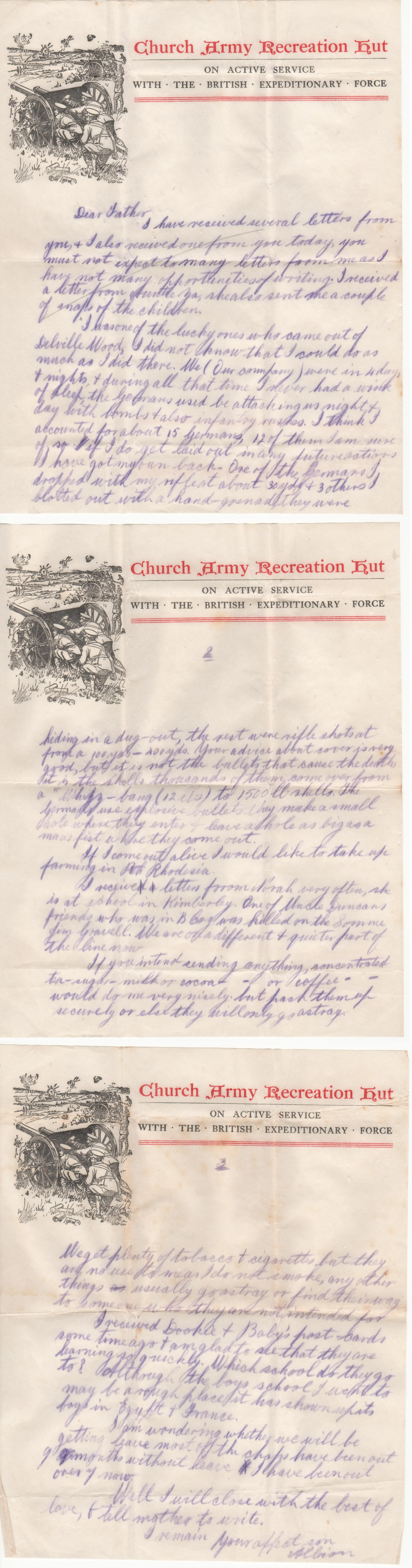
Dear Father
_I have received several letters from you, & I also received one from you today, you must not expect to many letter from me as I have not many opportunities of writing. I received a letter from Auntie Za, she also sent me a couple of snaps of the children.
_I was one of the lucky ones who came out of Delville Wood, I did not know that I could do as much as I did there. We (Our company) were in 4 days & nights, & during all that time, I never had a wink of sleep, the Germans used be attacking us night & day with bombs & also infantry rushes. I think I accounted for about 15 Germans, 12 of them I am sure of so if I do get laid out in my future reactions I have got my own back. One of the Germans I dropped with my rifle at about 30 yds & 3 others I blotted out with a hand-grenade, they were hiding in a dug-out, the rest were rifle shots at from a 100yds - 400 yds. Your advice about cover is very good, but it is not the bullets that cause the deaths, it is the shells thousands of them come over from a “whizz-bang” (12lbs) to a 1500 lb shells. The Germans use explosive bullets they make a small hole where they enter,& leave a hole as big as a man’s fist where they come out.
If I come out alive I would like to take up farming in Rhodesia.
_I received aletters from Norah very often, she is at school in Kimberley. One of Uncle Duncans friends who was in B Coy was kilin on the Somme Jim Gravell. We are on a different & quieter part of the line now.
If you intend sending anything, concentrated tea-sugar-mill or cocoa - or coffee - would do me very nicely, but pack them up securely or else they will only go astray. We get plenty of tobacco & cigarettes but they are no use to me as I do not smoke, and other things usually go astry or find their way to someone who they are not intended for.
_I received Dookie & Baby’s post cards some time ago & am glad to see that they are learning so quickly. Which school do they go to? Although the boys school I went to may be a rough place it has shown up its boys in Egypt and France.
_I am wondering whether we will be getting leave most of the chaps here have been out 9 months without leave. I have been out over 7 now.
Well I will close with the best of love, & tell mother to write.
I remain
Your affectionate son
Albion
Note, “Tell mother to write”.
We grew up under the impression that the mother who was not writing to him was the housekeeper turned step-mother, Iris Muriel Farr, but it was his real mother he referred to throughout his letters, and that was the “Mrs JW Corrie” of the court notice, the woman who abandoned her son and left him with the dashing military man JW Corrie. Alice Ellen Orren was widowed when he died in the siege of Kimberley, and she clearly took on Albion as her own son. Still, and I can’t leave this alone, he never mentions the step-mother in any letters, and certainly says nothing about receiving anything from her. Since she would not have him in her house, we can safely assume she was well out of any maternal remit, and he had no regard for her as a mother.
That does not mean she was not motherly. She was, but only to her own son, George Edward Cook, whom the family knew as “Ted”. I have the faintest of memories, as a toddler, of Ted visiting us, whether from Wits where he did his medical degree, or whether from Australia, where he emigrated to. It must have been a little awkward for Ted to visit, but there was clearly no malice between the three surviving boys. To their deaths, both my father spoke more fondly of Albion as their brother, where in fact it turns out he was not a blood relative at all. They were both small children who adored Albion and were heartbroken to lose him.
Both my father Hugh (“Baby” to Albie) and his brother Owen (“Dookie” to Albie) thought at worst that Ted was a bit of a fop, but I remember them all being civil to one another. It took decades for us to discover, thanks to the internet, that Ted had married and had children of his own. My parents saw very little of Iris Muriel Cook after TJ left. Reading one of TJ’s letters, it is clear why he left:
“For twenty-seven years, I took it: spiritualism for breakfast, lunch and supper. At last I could no longer endure it”.
Thomas James Cook skipped to Australia via England and the Meditarranean countries, and made his way toward Australia, island hopping from Ceylon through Indonesia and Malaysia. A man who had worked with him on the newspapers, GH Calpin,{{He wrote “There Are No South Africans”}} was said to have roundly criticised TJ Cook in his newspaper, but I never looked in either the Natal Mercury Archives or those of the Natal Witness for any such letter or article. Calpin somehow learned that TJ Cook, when soldiers going through his personal belongings on a ship, found a picture of him in Scottish military regalia, in a kilt, was pulled off the ship and press-ganged into drilling troops for Tshiang Kai Sheck on some or other island (Sumatra comes to mind) but I have no idea whether that is true. What I do know is that Calpin had no time for TJ Cook, and that was mutual.
Secret families
TJ Cook left PMB in secret in 1937, and arrived in Australia in 1939, and went straight into working for the war effort. He was by then in his late fifties. In time he moved to Hobart. Iris Muriel had placed newspaper ads looking for him in Perth, which I am sure he expected, and that is probably why he never went there. He ended up in Melbourne, where he died in 1955, having married “Miss Archbell” not long before he passed. There was a street named Archbell in PMB, so I imagine, since he surely must have been seeing her in secret, that both colluded in Australia as the ultimate destination. She left from Durban by ship. I do not know where they reunited in Australia, where they lived as man and wife for many years.
It seems he deserted Iris Muriel. She allowed the years to go by, and the rates and taxes to mount on his property in Boom St, then acquired the property by settling the outstanding rates and taxes. I found a telegram from him in his papers. It was to my father, asking
“AM I DISPOSSESSED?”
It would not have been the only issue that TJ with his wife. Or her with him. I think TJ was very naive to think that he could hang on to their Boom St house. He disappeared and paid nothing further toward the property.
My dad grew up not fully realising this, but found out that Mrs Iris Muriel Cook had salted away large amounts of housekeeping money that she lavished on Ted, part of which also went to educating him in medicine at Wits University. He and Owen were strictly raised, mainly on brown bread and treacle, but I wonder how uncommon that was in those days. I can’t imagine anyone lived well at all in the war years, and there was not much to celebrate when Spanish Flu hit straight after.
My father was nine years old when armisitice was announced. Both boys grieved sorely for Albion, for ever more hated the very notion of war, and felt lucky for not getting Spanish flu. Tuberculosis, if it had not killed Alice Ellen already in 1912, would surely have claimed her by 1919 at around forty-two years of age. We can reasonably assume, since I do remember Ted visiting in the late 1940s, that he felt welcome enough. It would have been awkward around his parent, but I have given up trying to understand her. She was pointed out to me in Church St one day, and I found her frankly scary. She had a pronounced squint, her legs were very bowed, and I could see why Fieke Ainslie gleefully exclaimed that old Percy Farr from Bedford felt very fortunate to have his daughter finally “married off”.
So, there is a whole family of Cooks in Australia that we know nothing about. One of the family youngsters discovered them on a geneaology site somewhere. I had searched for years, but I had been looking for “Edward Cook”. He was in fact “George Edward”, so I never found him, but also those geneaology sites, although they still make lots of mistakes, have improved.
Boy
Now to the reason I ended up putting this family story under the chapter on Cape Town. Firstly, it was a very small chapter, and secondly there is the connection with with my grandmother Alice Ellen’s father. But also, in the strangest of twists, it is bound up very closely with why I left Johannesburg and moved to Cape Town.
After my sister Colleen died, found myself one night in Yeoville with a hectically attractive person who had worked for Colleen. She was heartbroken about Colleen’s passing, I was myself grieving dreadfully, and one thing led to another. I suppose you could say we ended up ‘consoling’ one another.
One day (meaning: about 15 years later) she phoned me in some distress. She had a tumultuous relationship with the husband, and had set out to come clean about a number of “flings” or love affairs she had been through in their time together. She had time to own up to only one of those lovers to her husband. That would be me. He then hit the roof, giving her no time to out any of the others! I have had very few lovers in my life, so I feel a bit “why me?” about things, but - there we were.
So, I was the villain, the devil incarnate. I liked that man, and was naturally sorry about things. From time to time, I would come across them in Killarney Mall, pushing a pram, and it was always an awkward meeting. Not only because of the husband’s hate - it was distressing how easily it had come to that - I had been glad to call him a friend. Aside from that, but also because there was something disturbing I felt when looking into the eyes of the boy in the pram.
These meetings became fairly frequent, and I could no longer tolerate how I felt. I had longed to live in Cape Town for years. In the Noughties, my son came from England to check out his dad and South Africa. He had longed for the sunshine and more particularly the braai days, and I spent many happy weekends visiting him, catching up and braaing meat with him. When he was near the end of his planned three months, he wanted to see Cape Town. We went to see his sister at Rhodes University, and then I suggested a coach to Cape Town from Gqeberha. I confess to an agenda. I had a private bet that he would take one look at Cape Town and stay.
Well, what can I say? He said each hill the coach rounded, all the way to Cape Town, was a picture-perfect postcard scene, and Cape Town took his breath away. This is a boy who grew up in Johannesburg, whose weekends were often spent swimming, and who became a junior school swimming champion in Botswana. His appetite for South African was deep and unquenchable. He was tired of England, tired of English beer, tired of dour English society. He is SA born, could stay, so he did stay, and he never looked back.
On the last of my trips to Fourways area in Jhb to braai with him, a young, inexperienced driver irrationally gunned her vehicle against a red light, lurched in from of me in an intersection. There was nowhere to and I hit her nearly head on. I tore a huge number of ligaments, the crash unsettled some old fractures, and I have never really walked easily since.
Some years after I had regained some strength, out of work and after maxing out on all my credit cards, I used the Road Accident Fund money to settle the credit cards, and pay for my trip to Cape Town. It was while I was living in Fish Hoek that my sister’s ex-employee, she of the confess-to-husband episode, phoned, in tears, to share that her son had taken his young life in the most tragic way. After consoling her as best I could for some hours, she dropped a surprise bombshell that I could never have seen coming:
“I often wondered whether he was your son”. I can hear my father saying:
“Well. I. Never … “.
Exactly. I never … We met in the Brass Bell in Kalk Bay, and talked it through.
I will never know who his father really was. Her husband, I thought, had been a good father to him, and I have no reason not to doubt that. As to being his blood father, the strange feeling I felt always when looking at that little face in the pram in Johburg did make sense. He took after his mother very strongly, but, other than that, when I looked at that toddler face in the pram, I was seeing Toddler Me.
There are tribes and tribes within tribes. Even more strangely, I realised when I saw a photo of him taken shortly before his death, the face looking out of that image to me, was the spitting image of the young Albion William Corrie. Anything to do with Albion, as you may recall from me crosssing the Somme, feels karma-laden.
Pressed with the need to resolve a dread heaviness, I visited his grave in McGregor. As I stood looking at the grave, a movement caught my eye, and I looked up. Hovering two metres above and to my right side was a young martial eagle, looking me straight in the eye. I felt it was really the young boy looking at me. The eagle hovered, caught my eye again, flitted a moment, then wheeled away.