Angels
If I have ever had guardian angels, they were named Lorraine, though one was spelled slightly different. She was Laurie Venter, and a contemporary in the Fine Arts Dept in my university days.
Malcolm McKeown
Malcolm was my prep school bestie. There were others, but he lasted longest. By the time we went to high school, we had drifted apart, but I occasionally rode over to their place in Scotsville. He had grown up in a house in Berg Street, and both our families made the move to Scotsville by 1960. Malcolm’s father, Henry, was a civil servant, who, as “Mally” liked to recall, had worked with my dad, particularly on the Tomlinson Commission.
Malcolm tops this list because of a question he asked me at our 50th anniversary of Maritzburg College Class of ‘62. I found the question puzzling, and doubt that I answered it. The question was just four words:
“How did you know?”
He asked it intensely and with genuine puzzlement. I realise this is difficult for most people to understand, but friends as close as Mally and I were do not need to explain themselves to one another as much as to others. What he was really asking, rephrased more precisely, was “How did you know that apartheid was wrong?”.
The McKeown family was as principled and decent a family as you can find on this planet. What he perhaps unwittingly articulated in the asking was unsettling. He was a lawyer. While the rest of the world may see in a flash that apartheid was a legal no-no, to South Africans growing up in it, it was just the way things were. Very few people question things until they reach adulthood, and few as intently as university under-grads. Malcolm was no different from most, but it was clear, even as a professional with a generation of life and working experience, that he had accepted, rather than challenged, the status quo. Did he regret that? I think so.
An old boy tapped a glass, ready to speak, or there was a similar interruption: I forget now, but we returned to our seats at the banquet table. Mally was determined enough to return to the question when we got together again later at the reunion, but, in the usual confusion of findings and greetings of people unseen for half a century, it turned out too daunting trying to get enough quality time together to answer properly. We resolved to complete the discussion be email. Email just doesn’t do it for some people, and Mally said we’d get together again.
It never happened. The months go by. I can’t even remember how I discovered that he had passed away. It’s one of those terrible sadnesses: I had all my life looked forward to getting together with my various besties in retirement, to tell new stories, laugh at old onw, and just hang. The three main besties were Donald Hackland, Malcolm McKeown and Charles Gordon Ward. It is hard to convey how painful it is not to be able to get onto a stoep and chat with all three of these men, and enjoy our achievements and humour. Anyone my age surely knows what I mean.
Answering Malcolm
Here is the answer to Malcolm’s question. The situation, or the ethos we found ourselves in for those iffy forty years, was not what most people would imagine. What you can’t know, if you are born in Holland or England (historically, the two main perps) is that almost everyone grew up thinking that apartheid was intelligent, a real attempt to solve a very real problem, (that races don’t want to live like, nor with, one another, and that South Africa was proud to be the best and the first at it. We did not think ourselves zealots, we thought ourselves practical and truthful.
To this day, you will find way more half of the majority groups in South Africa, especially seniors, saying privately and in confidence, that black people want to live like white people. Just listen to Moeletsi Mbeki and Prince Mashele. What neither of those two (and most other commentators) say is that most people do not want to live with whites, and, in early days many did not want to live like whites. Twice in my youth, elder Zulu speakers told me emphatically that they did not want to live like whites: they didn’t want our clothes, they didn’t want our monogamy, they didn’t want our food, they did not want our houses. One of these conversations was with a man named Mnukwa, a headman on the farm of John Slatter, on the road between Greytown. The other was with a man in the Valley of a Thousand Hills, who had hailed me from high up on a hill while was running down the Umgeni River banks, learning my route and rapids for the Dusi Canoe Marathon. It was a peaceful moment, drinking surprisingly cool water in the deep shade of a grass hut. I was sixteen years old, and surprisingly unshy of several girls of about my age, who stared ceaselessly from across the hut. The were unclad from the waist up. A wives, brought me amanz’bandawyo {{fn: Cold Water}, another brought me a damp cloth. I was indeed dusty and muddy. I left the dwelling feeling this was not at all a bad way to live.
Political analyst Frans Cronje is big on enclaves, and he is right about SA. We are hundreds of enclaves-in-the-making.
This position of not wanting to live “like” whites, is I think, a thing of the past, but I can’t forget the stern distaste of both of those senior Zulus at the notion of a Zulu living like abelungu. not something that is openly admitted, but your closest black friends have no problems and will say so in private. About the most public it gets is at a braai, and then only among people, who have known one another for quite some time, and feel sure-footed about it.
We need to make a lot more brown babies before society will relax and just get on with life together. It is not that far in the future. My grandchildren are already totally mystified by talk of whites and blacks, and the older youth have married who they please. Marrying who we please, I would have eventually have told Malcolm, was my sticking point. I have written elsewhere that it is a very poor idea to tell a Cook that s/he can’t love someone. I told ‘Mac’ that simple logic alone showed apartheid was impossible, but what I should have told him was … church.
One Fine Sunday Morning
In St Saviours Cathedral 1, people were filing into to the pews. As usual, people entered from a door to the rear or side of the cathedral, behind where we were seated. I had enough hearing still at that age to have heard a commotion at the back door, entering from Commerical Road. Heads turned rearward, people stared, the church went silent, but there was no such commotion. That made it much stranger. A deacon, Mr Goble, hastily stood up and marched to the rear of the church, where a family had just entered. See how unremarkable that sounds? “A family had just entered.” So what? Well, this is where things get colonial … or churchy … or something.
For me, it was quite the thrill, because the family that had just entered was the most beautiful family I had ever clapped eyes on. Father was immaculate in a suit, tie, shiny shoes, not a hair out of place, mother in a stunning dress of perfect cut and fit, and two strikingly beautiful girls in white dresses with pastel belts, and the fashion of the day for kids, shiny shoes with white ankle socks, and with pastel bows and ‘vlieners’ in their lovely curly black hair.
Everything went silent. Mr Goble approached the family, and words were exchanged. While that was happening, one of the girls caught my gaze, and our eyes locked. Despite my catatonic shyness, I could not unlock. Then, with heavy resignation, the father ushered the family toward the door, and the family seemed to explode into baking Pietermaritzburg sun, exiting the cathedral. As they filed out, the girl looked back, our gaze locking briefly again, and then they were gone.
At six years of age, I could not be expected to explain, nor articulate any of this, but today, it is easy. More to the point, though, that beautiful girl was my first ever crush. It was surely the first time in my life that someone was so powerfully attractive that I wanted to cast my horrible shyness out of the windows and get closer.
With what would have been the best looking church day family gone, things returned to normal in the church. Except that, to me, that was abnormal. I later asked my father why the family had been asked to leave, because it was quite clear that was what had happened, yet sermons and Sunday School were all about love blah forgiveess blah blah. My father’s expression was conflicted, but he then said, (sheepishly?) “You will understand when you are older”.
Well, sorry, sir, but I never really did understand. The ‘problem’, of course, this being around 1951 in South Africa, was that the family were ’not white’, and what I was supposed to understand when I grew older was that they had ’their own church to go to’ and were thus not welcome at ‘ours’. My cheeks burned with shame, that day in church, and they still want to as I write. At that point, all grown-ups suddenly looked ugly to me, and they have, more or less, ever since. Including me! See a mirror? Walk faster!
It - apartheid - made no sense to me then, nor since, nor will it. Ever.
And that is what I wanted to explain to Malcolm McKeown. I didn’t know, I just am. Like Popeye the Sailor Man,
“I yam wod I yam, and I yain’t nuthin’ but wod I yam”.
Ian Coetser
Ian and I did the best we could by one another, through the decades.
In one or more of my PMB free lance bands in both Std 9 and Std 10, I had backed him in his capacity os a standup comic and a magician. He was hectically funny at the first and very polished at the second. We became friends and in time, I would shin over the wall of their property in Prestbury to join him to listen to jazz in outbuilding he had converted to a den.
He was into smoother, more modern jazz than me, but he was great fun to be with, and a genuine breath of fresh air as a scholar in Voortrekker Hoerskool. Although he had no black friends, he had trouble accepting apartheid, where most people just blindly went along with it. So that was a kindred thing, and not to be scoffed at. Another thing not to be scoffed at was a bit of happiness, a rare thing in my late teenage years, and it is true that Iam and I spent a disproportionate amount of our time together doubled up with laughter. I found him irresistible.
He married a magically beautiful local girl, Morri van der Walt, who had started her young life as a hairdresser, and moved into being one of the coolest and most creative ladies I had ever come across. Fashion was big in both of their lives, where I was, by contrast, a fashion disaster. I wore clothes simply to avoid being arrested.
After both of us had left for our stints in the army, it was many years before I reunited with Ian. By the time I found him again (also at a gig, but by this time in Jhb), he headed his own very successful advertising agency. He was artistic and very fluent in both offical languages. It was a joy to reunite with him, and he would phone fairly often and invite me to his lavish parties up in his amazing house at the top of a knoll in Robindale.
Like many in both the ad and fashion worlds, Ian had developed a recreational marijuana habit. He thought it harmless and fun, and like many at the time, that it was a cut above alcohol. Many of my friends stayed with recreational marijuana, never developing a taste for anything stronger, but Ian, under the pressures created by a very dubious crowd of predatory lawyers and accountants, who appeared to hover and wait for adventurous debt levels (I have no doubt his accountant, who came across to me as a low-life London East End gangster) was in league with shark lawyers. I suspect he divulged cash flow weaknesses) and pounce.
Ian made his way steadily through four fortunes, each time landing victim to the ‘money boys’. In the end, pressure and drugs won. Toward the end of his life, he began to borrow from me, and I never refused. He had lost his teeth to drugs, and was soldiering on selling art from the boot of his car. It was never going to last. I am so sad thinking of him: he was one of the trusted few whom I looked forward to sharing some stoeptalk with in my old age.
Laurie McCarthy
She was the only person other than Prof Jack Heath to pick up that I was hungry and too poor to afford food. One day she arrived at my loft in Leinster Rd, climbing the steps with a large basket. She crept up the ladder into the loft, placed the basket on a table, conversed for a while, then said “eat” and left.
Her mother Phyllis was generous, too, she used to pitch at our sports grounds in prep school, laden with candy floss, cream buns and fizzy cool drinks (“Meldrums” was the brand she favoured), and hand treats out to all the boys. What her daughter left was a huge basket of fresh fruit with a few packets of mixed nuts.
I knew her as Laurayne or Laurane, or anyway not the usual spelling. I found online that she is no longer with us, having passed in 2013. I played at her wedding with her guy Mr Venter, whose first name I forget. I liked him. The wedding was held at their farm, Glenaholm in Town Bush Valley. The reception party wound on until the small hours, ending with Mr Victor McCarthy joining me at the huge baronial fireplace, where he plied me with endless whiskies, chucking each successive whisky tumbler into the fireplace and applauding the little bursts of flame from the dregs.
We laughed so much we must have looked like Peter Sellers and Herbert Lom in the ‘dentist laughing gas’ scene. Chris Roering joined Victor and me for ‘a couple’ then dragged me away, shortly before first light.
Thank you Laurie Venter, I will never forget you.
Lorraine Hurdus
Another Lorraine was Lorraine Hurdus, whom I met as Lorraine McArthur. She was a fantastic supportive friend through all of our working lives together with the African Jazz Pioneers. A couple of times, I nearly came apart at the seams (the AJP was a high-intensity eight years, and she was there for most of it). She even made it to my eightieth birthday (at the railway station in Sedgefield), having traversed the massive coastal hills and valleys all the way from the wild coast in a haphazard succession of rural buses (you know the ones: you are lucky if the goats travel on the roof - even I paled at the thought, and I have been everywhere) and kombi-teksies. What a hero!
Of all the many beautiful pictures that abound of Lorraine, the one with Big George Lea Larnyoh shared in FB by Andrea Larnyoh is how I remember her at the time we met.
Like with all the best friends, it started with a quarrel, and those were always my fault! She was right, and won the fight - of course. I am so glad. At the time she was managing ‘Bayete’. Eventually, she managed the African Jazz Pioneers for many years. I had the most memorable times with her. Two that stick are drinks in pre-ANC government times with Trevor Manuel, Pallo Jordan and another (possibly Mike Mnisi) in exile during our stint at the Lionel Hampton Jazz Room at Hotel Lafayette Paris Etoile.
The other was a happy night moving from Rumours to a sidewalk near the Lizard Lounge in Rockey Street, Yeoville, where we sat happily sharing a bottle of whiskey between us, seated on the pavement, feet in the road. I commented that they must be filming down near Bezuidenhout Road, drawing her attenion to the arc lights.
“That’s the sun coming up, you idiot”.
That woman is always right. I could fill a chapter of the fun & hard times we shared. Love you Lorraine, and your ace, (and like her gentle, brilliant father Mpho) talented and beautiful daughter, Lyla Faye. Don’t allow these two ladies to walk together down a busy street. Serial motor accidents shall result. For a mass pile-up, just add friends Thembi Mtshali-Jones and Faith Kekana. Good name for a song: “Talent Phalanx”!
Lorraine Steyn
Lorraine and partner Steve Mabbutt (SA’s greatest white hat hacker - I think I have the hat colour right) were often in the audience in the ever-heaving club “Roxy Rhythm Bar” in Melville, Johannesburg. Lorraine is one of those hypnotically attractive people one picks up in a crowded room, and to whom one’s stare magnetically returns.
There are some things one cannot fight. One of them is a move to a place you have always dreamed of living in. I left Johburg driven in just that way, but soon found myself living on water again in Cape Town.
Lorraine Steyn saw my plight, and, as is her way, she did something about it. She put a lot of trust in me: I had no track record in IT, but she may have recalled I had written a few technical articles in a long-dead journal named SA Computer, a mag that her partner Steve also wrote for. She found temporary work for me, a two week IT job at a soft goods retailer. She plays this down, but I think she worked hard to create that opportunity for me, and it did turn into a golden goose, lasting for years.
She later hired me again as a software tester. That is how I came, at seventy years of age, to enjoy the best job I ever had, with the best group of people I had ever worked with, for three happy years.
Thank you, Lorraine, for saving my life, time and again. I miss you and the happy days working in the big house with Alain King and all the other geniuses. Something radically remarkable about Lorraine is how much work people get through in her endeavours. Heftily sarcastic about how “productivity” is talked about, and to paraphrase old Winnie
“Never in the field of office work has so little work been done by so many who talk crap about productivity”
I have always tended to scorn biz-talk about productivity, but that is because of how hard my working life was from its start. Yet, in Lorraine’s software business, I found really busy people endlessly and cheerfully doing things. I don’t know how she does it. As you saw above, I am hugely dismissive, equating “corporate” with “bullshit”, more likely to be influenced by this theory than C. Northcote Parkinson and his law, or Laurence J Peter’s principle. No matter how true those two are, Lorraine is another story altogether, and makes things fun while at it. I hugely admire her.
Thank you Lorraine, for granting my the best working experience of my life, right there at its end! My faith in business was restored. It is great to find real human beings in the business world.
The Georgina Beard Story, Pt 1
It took me long, long minutes to pluck up the courage to approach Georgina, but was made easier because she was in dire need. Her dainty feet froze! It happened one afternoon at Waterloo Station in London. I had been laid off work because of an approaching blizzard.
Work at the time was with a gang wearing tanks on our backs, spraying weeds on rail tracks in the vast Temple Mills marshalling yards in London, now the maintenance depot for Eurostar.
I reached Waterloo before the blizzard began, but it came on strongly and quickly. My destination was Barnes Bridge Station. On fine days, Barnes Station would have been the better choice, being a lovely walk across the common to Ranelagh Avenue, but I did not fancy the walk exposed to a blizzard in the common. Barnes Bridge was the better bet on this day, because, the walk from there passed The Sun Inn, where there the prospect of half pint of bitter next to a heater or fireplace in a cozy pub appealed. There was no heating at all in my lodgings, and I was alone there at the time - no possible body heat to look forward to.
Electronic signage had not yet made it to the station. Trains information was a large board with hooks onto which varnished wooden signs with gold lettering were hung, giving destination details. I knew that behind the trains indicator board was a nice wind-free ‘pozzy’ where I could shelter from the by-now icy gale blowing through the station. The plan was scuppered: ‘my’ spot was already taken.
There stood a beautiful blonde, in a long rabbit-pelt coat. I pegged her straight-off for an Aussie in that coat. Only Aussies wore rabbit pelt coats, sensible, since there was never going to be a shortage of rabbits in the Big Oz. I stood some yards away in the sleety wind on the platform, but this girl was very pretty, and I must have stared - a lot. Frankly, I was mesmerised. It was a long time since I had clapped eyes on anyone quite that good looking at such close quarters, but then something else took over. She was very, very cold, and began to shiver. The thing was - her shoes. She was wearing very stylish but very skimpy sandals - wrong shoes for blizzards.
The shivers were small at first, but soon developed into shakes, and the shakes began to approach convulsion level, when I could not endure it any longer. just then, a warm Jamaican voice announced on public address that a special heated train was to be berthed in Platform 19. I lost my cool, walked to the girl, said “Come with me” and yanked her toward the train as it was gliding into the nearby platform.
There was a near-stampede boarding, but, once in, I looked for a seat for my plan. There was none, so strode to a bloke in the middle seat of one row, and said “You’re sitting over there now” and pointed. He gulped and moved, and I pulled the blonde, now fairly dancing with cold, into the seat, sat opposite her and reached for her feet.
Warmly dressed in a camouflage jacket, with a pullover over a shirt over a tee shirt, I yanked all my clothing upwards from my belt, took off her sandals, and placed her frozen feet right on my burning solar plexus. She was startled and voiced discomfort, but, within seconds, calmed down. My body heat was doing the trick. The Poms all around us looked everywhere but at us, but you know what they are like - their eyes rolled and lolled, but in the end, with straining peripheral vision, they craned to get a better look at the weird colonials!
When she had warmed up somewhat, she said, in her Aussie accent
“Four days ago, I was standing in a hundred degrees Fahrenheit. I never believed I could get this cold”.
I sympathised. “I come from a warm country too”. She asked “What country is that?”. I told her. “Oh well, I came from there originally, a small town, I don’t know if you know it, called Pietermaritzburg”. Blow me down with a feather!
She went on to say that they had lived opposite the university main gate, and then I suddenly remembered her. Well, not the her I was sitting opposite, but a happy, blonde toddler. I remembered the Beard family lived there, and remembered one of the older girls, a contemporary of one of my sisters, also at the gate, calling the little blonde. It took only seconds further to confirm that she was, as I put it, “one of the Beard girls”, and her name was Georgina.
By the time the train reached Barnes Bridge, my solar plexus had done its job. Georgina’s frozen foot crises was abated, we exchanged details, and I promised to contact her at her Windsor address, where she was learning horse breeding.
We did see another once more. She drove to Barnes in a spiffy little yellow Mini Minor (and a very cute outfit). Both our lives were complicated by other people in them and we agreed not to follow up. I lost touch with her totally. Georgina is unforgettable, and for decades after that, I wondered what had become of her. The story of how we met became one that I told many times at supper parties and braai-parties, and, fiercely as I hoped to see her again, I slow accepted that it was unlikely that I would, ever again. Luckily, I never ceased telling that Waterloo story.
The Georgina Beard Story, Pt 2
Decades rolled by. I had met Georgina in 1968. I never stopped longing to see that feisty, beautiful, blond mfushani again. One day in the late 1980s, I was invited to a supper at my sister’s 20 Hopkins St house in Yeoville, Johannesburg. My elder sister Colleen and her husband Mike Taylor had a thing going where they had supper with their large number of friends all over that city, and held many banquet-sized dinners at their place to reciprocate. Mike Taylor was a lecturer in Archaeology at Wits. I was to hear stories about students of his from time to time. There were some well-known ones: Bruce Fordyce, Johnny Clegg, and Alain King being three that I bumped into in my various working lives through the years. Mike’s professor was an American, Tom Huffman.
At the 20 Hopkins table were seated ten diners, among them Mr Huffman, who that night was not accompanied by a partner. At a point where the conversation lulled, he piped up:
“Jasper, tell us a story! We know you have great stories” He turned to the rest of the company, saying mock-confidentially “We know his stories are lies, but - hey they are good lies, y’know”.
Lorraine Steyn knows better than to encourage me to tell stories, but Tom didn’t. He may have got a hard look from Mike, but I had a few beers in me, and sailed in on the story of the beautiful Aussie blonde I had met on Waterloo station, who turned out to have lived a couple of blocks away from us in Scotsville, Pietermaritzburg. I did not bother with names - it was unlikely that anyone at the table other than Colleen would know the Beards anyway. The story had a good response: we were all well-oiled, and all Colleen’s dinner parties were uproarious fun. We all left flushed with food, booze and stories.
Crackers Deli
A couple of mornings later, I was in Crackers Deli, down Rockey St, Yeoville. It would have been a Saturday morning, because Saturday breakfast at Crackers, run by a Jamaican man named Ridley Wright, and his gracious and lovely South African wife, was my regular thing for some months. Sadly, Ridley was to be stabbed to death some months later by a drug dealer. Tom Huffman came through the passage, waved and headed for our table.
I need to pause to say something about Crackers Deli and those breakfasts.
After a few weeks of waving a greeting to James Phillips (aka Bernoldus Niemand) passsing through the same narrow passage adjacent to Crackers, James had one Saturday joined me. I enjoyed his company. He was a real hoot with a unique turn of phrase, and the table, over the weeks following steadily grew, so that Ridley cobbled tables together to accommodate more than six at times.
Today, I sorely wish I had somehow been able to secretly record those breakfasts, because, when I say the table grew, it was not because I had the power of attraction to grow a huge breakfast table at the Deli. That would be James, and we was routinely joined by people who became storied disrupters, all famous as ‘die Alternatiewe’ (the Alternatives), courageous in their humanity, their fun and their ribald resistance to churchy Christian Nationalism. There was no formality ever. No one was introduced. I scarcely knew their names, nor they mine, but we all knew each other as Yeoville faces and instinctively trusted one another, and were in things together for the anti-ruling, anarchic glee there was to be had for mocking, pillorying and dissing apartheid in all its faecal glory.
Many who joined us at breakfast did not survive to old age. Some were claimed by motor accidents, as are far too many musicians, and others succumbed to other pressures, not the least of which was that they were reviled by other Afrikaners as poisonous veraaiers (traitors): believe me when I say it was a heavy fate to be an Afrikaner and publicly reject apartheid back then. Far too many brilliant and talented minds took a terrible toll and paid the ultimate price. Their memory is jointly remembered, celebrated and revered in the song ‘Flowers of the Nation’ written by Bra Jonas Gwangwa in memory of the youth from all groups who gave their lives in the struggle.
One morning, James, Gary Onselman and others had already got going when I spotted Tom Huffman in the passage and waved. He stopped, came in, and gave me an address in Buckingham Ave, Randburg, told me to come to that address the next day. Of course, I wanted to know why.
“Be there!” said Tom, and left.
Yay! A mystery! Who doesn’t love one? The following day, I found the place. The door was answered by an attractive lady who I strongly felt I should know, but I could not put name to face. “Hello, Jasper”, she said. Wow. I never even got as far as explaining who I was, nor why I was there. “come through” she said, and led me through the house to the back garden, where a few people were seated around a table in the sun. The hairs on the back of my neck began to prickle. A blonde, seated with her back to me, stood turned, and I was speechless. “Hello, Jasper” said Georgina Beard.
Me, speechless, is not generally a thing. I must have sounded like the ‘cowboy-injun’ comic books, blurting “How? How? How?”
The lady who had answered the door was Georgina’s sister, Rowena. It emerged that she and Tom Huffman were ‘an item’. Tom had retold the story to her and to her sister, visiting on her way through to Australia, that this guy at supper had told a few nights ago, about meeting a beautiful blonde in a blizzard at Waterloo Station in the Sixties, warming up her frozen feet, who had turned out to be from the same town as him.
It was Tom’s turn to lose the power of speech then, because I had never mentioned any names in the story, yet Georgina asked Tom: “This guy who told that story - is his name Jasper?”.
You can imagine.
Georgina and I are still in touch. I visited her in Perth after than when I toured there with the AJP in Perth in the early Nineties, and she generously indulged me by flying me from Melbourne to the Gold Coast where I spent an idyllic few days with her on her farm ‘The Pocket’ in Billinudgel, NSW in 2012. Chris Roering had generously flown me to stay with him for a few weeks in Darnum, an hour and a half from Melbourne, Victoria. I will never forget your generosity, Georgina, especialy knowing how hideously expensive internal flights are in the Big Oz.
“Big Mickey” Vilakazi
I never knew Mickey personally, but it is worth mentioning that his ‘Hellfire’, was remarkable for it being one of the few (if not the only) marabi songs that changed key. It had two sections, first in E flat, moving to A flat in the bridge. Many marabi songs do not even have a bridge section. The song as re-worked by the African Jazz Pioneers, even had the makings of a shout chorus, also in E-flat. That section was added by Stompie Manana in early AJP days, and it stuck. Mango Groove never used it. The sections look simply like this - Mr Manana’s contribution is Section C:
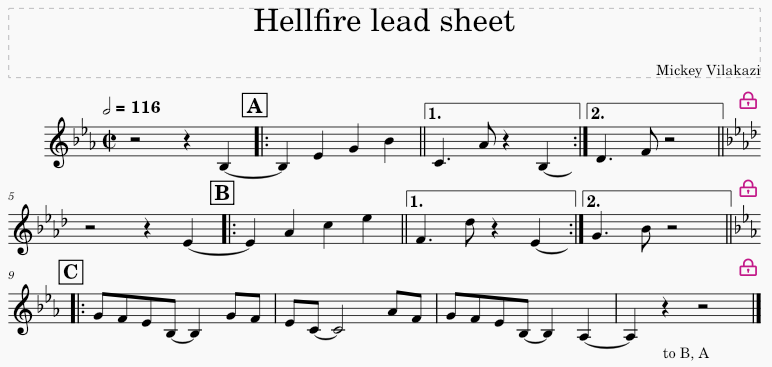
This change of key became a challenge for bandleader Ntemi Piliso. He set out to compose a song that also changed key. After trying many modulations, he eventually decided that moving to a key a major sixth away from the current key was the answer. The result of his dive down that rabbit hole was Shufflin’ Joe.
Rehane Abrahams
Rehane and I have been friends since early 1990’s Yeoville days. I spotted her at Time Square one day, and my shyness broke. This lady has enormous intellect and power of attraction. In time, she joined me for a few days in McGregor, WC, where I was staying with Kate Shand. The two of us roamed the fynbos hills all around McGregor, Rehane keeping pace tirelessly. I can’t walk like that any more, but she is still as lean and fit as ever. We stayed in touch through the years, and when I popped the question about a possible trip to Bali in 2012, she said “Just come”. And I went. I stayed in her outside cottage for a month in Ubud, a very convivial time.
At her bidding, I visited two healers, the most remarkable of which was a lady named Ida. This lady suggested ‘probing’ for 45 minutes, then treating me according to what she found. I agreed.
The probing was exactly that: touching and feeling. People in Bali have been doing this for 5000 years, and are very sure of it. After a little longer than 45 minutes, Ida refused to tell me what she had found, but did say it was not ideal. Her tone of voice was more like “it is serious” than “not ideal”, but I will never know. I had arrived in Bali in bad shape, and her probing diagnosed all that I knew I was suffering from and more.
Treatment was intense acu-pressure: at a point she used her entire body-weight pressing her elbow into my back. It was, if there can be such a thing, ‘good pain’.
Afterwards, Rehane and I had planned to head to an incense factory to see how that was made. Out in the blinding 45 degree Bali heat, and as I was mounting the pillion seat of Rehane’s motor-scooter, we both spotted my knees, oozing fluid through the long khaki shorts covering my legs to mid-calf. It was weird: as if all my perspiration had gathered and concentrated itself to emerge from just below my kneecaps, through an oval stain on the trousers.
Nothing like that surprises me: I had seen a healer in Johannesburg, decades before. In two sessions of passing his hands over my back, not touching me at all, he had healed verterbrae fractures, mystifying two defence force doctors who compared before/after x-rays. Rehane and I joked about how, by the time I landed back in SA, this story would be amplified to “high speed jets of water shot out of his kneecaps”. Didn’t happen.
After I returned to Cape Town, Rehane married and lived in Fish Hoek for some years. I had left there for Woodstock. I visited her in her house in Woodstock, a house she then housed her parents in. A few weeks ago, we were in touch about the passing of her mother, Cass, a famous Cape Town chef and author. I had never really thought of cooking as a talent, but when Cass had put on her apron and prepared a waterblommetjie bredie for me at one of her restaurants, I instantly changed my mind. It felt life-changing to the taste, and I have to say die appel van nie ver van die boom af nie, because Rehane, when she dons an apron, has the same talent. She just rather directs most of her talent to theatre.
Ashleigh Ward
I struck up a conversation one night at Rumours, Rockey St, with a hectically attractive young lady who was actually waiting table for Nick, next door at his Greek restaurant, Scandalos, though she did also work at Rumours. She was fun, and that developed into a relationship. I had not expected that. She was in her early twenties, I was 48, but there it was. After the closest times together, my elder sister Colleen passed, and I was terribly grief stricken. That and the excessive boozing that went with it resulted in my doing a lot of tearful venting. Sorry Ashleigh, wherever you are now (in England at the time of writing): I am sad to have saddled you with the worst of my grief. You were the happiest relationship I ever had.
Jake Pressly
Jake gets the prize for ‘World’s Most Persistent ‘Bone Hunter. In the 1970s, he phoned me at home in Troyeville, and asked me to join his big band. I am unsure whether it was already named ‘Fat Sound’. I turned it down at the time. I was just too busy doing other things. Jake was undeterred. Some weeks later, he phoned again, and continued doing so for years, month after month! In the early days, the band was rehearsing in Sandringham. I have not heard the band, but I liked what Jake was doing with his ‘Jump Band’. I heard that band in Braamfontein, and it knocked my socks off with renditions of the Johnny Hodges band, a smaller group of Ellington ‘alumni’.
Terry Hamilton
I had completely forgotten that in the 80s, I co-wrote, with an Oz friend, an accounts program, called Personal Accounting. I did maybe 2% of the code, just some cranky complex working innards. Friend Terry wrote the bulk. He sold 3000+ copies at R3.5k per copy. It paid his family’s return tickets to Oz. One of his beautiful twin daughters found me in Killarney in the early 2000s, but then I sadly lost touch. The last I heard from him was he had teamed up with an Oz farmer who had found white deposits in his ploughed lands. Experiments revealed that this substance (I think he called it ‘Orms’) was a superconductor, & could, if he got it correct, be transformed into gold …
We spoke once (that alchemical tangent still excited him, but he was not skatryk overnight, so it must have foundered) after that, an expensive trunk call that busted my entire month’s food budget. I wish he were around now, with these WhatsApp calls. If ever there were a person who could make wampum out of nothing, it was he. Always reminded me of O Henry. If Terry were from the Deep South, I could imagine him saying 2
“I, Samontine Pike, was plumbin’ a legitimate line of graft south of the line, when Zeke Sandervee first divulged the recipe for Snake Eye Oil Water”.
Terry lived at Halfway House, between Johannesburg and Pretoria. I drove out many times to visit. His was a startlingly good looking family: wife Jean, twin daughters Belinda and Amanda, daughter Lindy and daughter Lily.
Teddy Hocken
Adding to the list (see Pretoria section) of musicians who had a profound effect on me, Teddy Hocken has to be up there. I bought two of my trombones from him, a King Duo Gravis bass trombone, and a gold brass Bach 12. Ted refused to sell me the Bach 12 at first. When I asked why he didn’t really explain. I tried him every year for four years, and he finally relented. Just as well, because a drunk reveller fell on my Bach 36 trombone (the one I recorded Ten Ten Special on) slide when I was at full stretch in 6th position, and bent it into a “U” shape. When I finally did collect the long-awaited Bach 12 from him, Teddy at last divulged that, although he had told me many times it was not his favourite horn to play (he liked a King 3B or 2B), he had hung onto it for sheer sentimentality, because it was a present from Dick Nash. Ted visited Dick Nash many times in LA through the years, and I am not surprised he didn’t want to let that horn go.
I was glad to have both those horns from Teddy. They both turned out to be amazing horns to blow. It strikes me now, as I write this, that I have never owned a brand new, out-of-the-box horn in my life. With our exchange rate, they were out of reach for me, in fact the going joke was “only Africans can afford new instruments”! 3. That is not to say I never played a brand new horn out of the box. While in the Entertainment Group, I was issued a brand, spanking new Getzen Eterna Doc Severinsen model trumpet. It was a wonderful, easy-playing, good-sounding horn, plenty of spread and projection.
Teddy told me he had “never been a full-time pro”. True or not, he was to me a notable trombonist, and probably more. At one time, George Hayden told me, Teddy was a multi-instrumentalist, playing smaller brass like trumpet and cornet, but also a reed player. I actually bought a clarinet for my daughter Nandi from him, and he offered a flute by way of a double bundle. I did not have the cash for both.
What struck me about him was he never gave up his “day job”, yet took on every show there was to be had, and still pitched for work early every day, and more particularly, still pitched for shows every day. He was just plain tough. Most of the shows played Tuesday through Friday, one show per night, then Saturday would mean an afternoon show, and an evening show, and the same with Sunday. I played shows that were even busier (greedier?), with an afternoon, evening and night show on Saturdays and Sundays. Teddy would take shows on either bass trombone or tenor trombone. He was a quick sight-reader, and had no embouchure problems. How he got through these seasons without taking a break from shows is hard to fathom, but that was Teddy. By the time I met him, he was in his mid-fifties, and he continued working this way until live stage shows dwindled in the nineties. He was born in 1925, I think (a very good year for jazz musicians, Oscar Peterson being the most famous for that birth year — see wiki — 1925 In Jazz), so he would have been in his seventies (and retired from his day job) by the time the “pit bands” were consigned to the past.
Lionel Martin Pillay
In a recording session, Lionel was on piano. A wide piano part was draped along the full width of the studio grand piano. I guess it was seven pages or more. Lionel had time to glance at the part, but then the MD could not find the score. He asked for the piano part. We did a run-through, and a take, without Lionel seeing the part again. I was stunned. He had memorised the part in, what was it? Twenty, forty seconds? I was to play many more times with Lionel, and it was the same every time. His baby face was all over the room, and he never took a second glance at a part.
“Fastest pianist in the country, but not in town” was his joke, and that was true, too. His speed on the keys made me think of Art Tatum and Oscar Peterson. As for arranging, he was a shade behind George Hayden. George had no need to check voicings on the gig. He could hear, in his mind, how a voicing would sound. Lionel checked a voiced chord in the sax section, just once, in my experience; George never did, Victor Ntoni checked voicings ad nauseam.
In my mind, there is something of a trend toward amazingly talented jazz pianists of Asian descent. Long before I ever heard of Lionel Pillay, I was at a concert in the Main Hall at UNP, enthralled by a trio plus guitar. I don’t remember the drummer (Cecil Ricca comes to mind) and bassist names, but the pianist was Chris Joseph, and the guitarist was Kenny Japtha. This was an incredible night’s music. Another amazing pianist of Asian descent is Melvin Peters. I had the privilege of playing a few numbers with him one night, a really rewarding experience. The really great pianists, in my experience, make it really easy for a horn man to play with them, and Melvin is like this, as was Lionel. No obfuscation, no piling of substitute chord upon convoluted intellectual substitute chord, just pure, good-sounding piano. What a pleasure!
Victor Ntoni
Unlike Lionel Pillay and George Hayden, neither of whom had a problem ‘hearing’ a section voicing in their minds, Bra Vic Ntoni was always at it, running voicings over and over again. He didn’t have the sounds down in his ear or mind. We would stand for hours, repeating this note and that note. I even got the impression that Bra Vic did this to impress, and maybe it worked on others, but not on me. I was used to getting a written part placed on my music stand, ready, count in, go.
Bra Vic, instead, would give us a pencil and a blank part, and ask us to write our voicing (if not the entire part from the score, something he did even more often) ourselves. Never once in all of the times I played with Bra Vic was an arrangement ever complete on arrival. Usually, anyone walking into the studio would find musicians on all fours on the carpet, arranged at all angles around a score, copying parts. Bra Vic did many great things in his life, but I am not happy to rank him as a “genius” arranger, not next to George and Lionel. Ace bass-player? Yes, absolutely. One Grahamstown Festival, Victor was on double bass 4 with the Darius Brubeck Quartet. Darius on piano of course, and Lulu Gontsana Jnr on drums. Ezra Ngcukana appeared, climbed on stage, and called Ray Noble’s “Cherokee” at a truly formidable tempo.
I think the plan was a ‘cutting contest’, an old jazz tradition. Ezra was taking on Barney Rachabane. Soon, Bra Winston Mankunku appeared on stage. Ezra had his work cut out. Each of the three sax players played extended solos at this totally blistering lick, and then traded fours for several choruses.
Double bass is hard work. Victor, though, uncannily never even broke a sweat. For the whole of more than half an hour while the sax players indulged themselves, he stared straight ahead, in a trance. Darius and Lulu together also careered on. They began to watch the soloists carefully at a late point, possibly hoping for a conclusion to this athletic chase, but Vic was unconcerned, steaming onward. It was an amazing display, and a marathon cutting contest. In my own opinion, though he was an amazing player, Ezra bit off a bit more than he could chew. It became the Barney and Winston show!
Bra Vic also did an amazing job, deep in apartheid years, of combing through the SABC archives, finding lots of original material by black SA composers and band-leaders, material that would have been lost forever were it not for Victor’s efforts. I have many times wished for a re-screening of those amazing videos. Once (no idea now how this came about) I visited one of the bandleaders of whom footage was found by Bra Vic. His name was Winston Siljee. He was a real gentleman, not at all young by the time I met him, and his band had knocked my socks off when I saw their footage.
Bra Vic booked me for some years. Although he was the least organized band leader I worked for (except for Dennis Mpale), I enjoyed working with him, especially when he was in good shape. There had been long periods where he followed good habits, and it was always fun being with him those times. One day, during a time when I was working a day job with a publisher, really struggling with a part-time job to get by, he phoned and booked me on a gig. His rehearsals could take days sometimes, costing me the opportunity of getting the rent and food together in my temp job, so I asked him what the gig was worth. He lost his temper on the phone, told me I asked “too many questions. Forget it, I am not booking you again,” he said. And he didn’t.
That really hurt that time. It is a basic right to know the details of a gig beforehand. We all have lives to plan. It’s true I had never asked for such details before, but I was in desperate straits, and really needed to know what was what. This sudden ranting call left me with the impression that I was off this gig, as well as all future gigs, which turned out correct, though I found out in a strange way some days later. I pitched up at the Market Theatre to participate in the launch of a project. I had recorded some experiences relating to my life as a performer under apartheid as part of that project (I think it was called “Ubuyile”, not sure now). As I entered the door, I met Bra Vic. He immediately sulked and lost it, saying, “Oh man, what are you doing here? I didn’t book you, man!”. I had no idea that I would find him at this function. Fortunately, someone intervened, explaining to Bra Vic that I was their guest, as a participant in the project. Bra Vic buttoned his lip, but turned away looking absolutely furious. He never, from that night onward, ever talked to me again, right up until his death. It felt very weird.
The event was pleasant and I waited for things to unfold, meantime finding many people to greet and chat with. Tim, tenor saxist Pioneer and husband to ex-AJP-manager Sis Queeneth, was there. He strolled over and asked what the hubbub between me and Bra Vic at the entrance was about. I never got a chance to explain, because Bra Vic also appeared next to Tim. Tim said to Bra Vic, “I came here to hear Jasper playing”. Bra Vic went through the whole histrionics again, and when Tim found that I was not, in fact, playing, he said to Bra Vic, “Well, I came here to hear him play. So, now I am going home”. And he left. Stranger than fiction, all of it, especially given that anybody listening to Sis Queeneth (Tim’s wife) talking about me would come away convinced that I was the devil incarnate!
The band was a disappointment. I was really keen to hear how the trombone section sounded, but there was not much experience there, with the result that they sounded very quiet, very shy, very unsure of themselves. I have seen a video of a trombone shock wave, so was looking forward to hearing a hopefully powerful trombone section, but that one was never going to be it. Later, Mpho, one of the trombonists, told me what the gig paid, and that was a worse blow, because it would have paid my daughter’s university fees straight off. Instead, I had to jump through some tense financial hoops for the rest of the year, but, what the hell, here I am. I made it somehow without Bra Vic. Still, I wish we could have parted on better terms. How am I supposed to understand how or why he suddenly decided to detest me?
Alan Wright
Al Wright and I continued our friendship after I left the army behind. He stayed on, eventually gaining a promotion to leader of the Army Band after democracy. I think the SADF Entertainment Group had ceased to exist by then anyway.
The promotion was stressful.
“They went out and combed the streets of the East Rand and more, and basically shanghaied people into the army,” he said. “The ANC had claimed forty thousand soldiers in exile, and they had to ‘find’ them. There was a big budget in play.”
So, Al found he was in charge of a group of youngsters who were neither hot players, nor were they a good fit when it came to military conduct and discipline. A few years later, he complained to me:
“About 80% are on AWOL court-martial charges. The system is so backed up, most will never come to trial. They have no understanding of how serious this is in military terms, nor do they care. They just collect a salary, and mess about.”
This bitterness, hard as it may have been, did not appear to affect how much Al put into the job. He was no slacker. He also continued his busy life, putting his usual hours in with the Salvation Army corps bands, and continued to improve personally as a trumpet and cornet player. Not many people know that he was for some years in a principal position on bass trombone with the NAPAC (Natal Performing Arts Council) Symphony Orchestra, as a young man.
Dan Selsick
Years before I played for the AJP, Dan Selsick was the trombonist of choice for a fabulous band named “Thetha”, led (I think) by Rashid Lanie, who later spent years working in the USA. Dan and I eventually became close friends. We were both, I found, friends with Alan Wright, with whom I had worked closely for years in the SADF Entertainment Group. Talking about sight-reading, I was never able to regain my sight-reading ability. Dan had a different take on both my self-confidence and my sight-reading:
“Not enough game time” was Dan’s verdict, and I am sure he was correct. If you are a second choice, you stay a second choice, because only first choices get enough game time to hone their skills.
There is another aspect to this: my life in music was most importantly a question of rhythm, of making rhythm while playing. In jazz, everyone is a drummer, whether they play drums or not. Have a look at Mel Tormé with Ella Fitzgerald. He was a vocalist, right? Yes, but why not have a look at him wearing a different hat? You will see what I mean. If that is not enough, you know that Lionel Hampton was known for vibraphone. So, have a look at both Mr Hampton and Mr Tormé pitting themselves against two of the world’s most famous jazz drummers. More people are drummers than most of us guess. Trumpeter Roy Eldridge’s first instrument was drums.
Recently, Dan has joined John Davies and other musicians, playing alternative instruments, just for fun. Both Dan and John are know as trombonists, but in their new band, heard at the Radium Been Hall in Johannesburg, Dan plays guitar and John plays piano. Most remarkably, John only learnt piano in midlife.
John Davies
Years after leaving the AJP, I was booked alongside John Davies to record an album with Hugh Masekela. Because the music scene has changed and we move on to other things, some people may not have heard about John Davies. He was in a class all on his own here in SA as a trombonist. Nobody came close to his ability, his technique, his fire and all-round accomplishments on trombone. He went into teaching young bands, the National Youth Orchestra and more, and if anybody changed the musical education world here in SA, it was John Davies. After we had finished the rehearsals, recordings and had it all “in the can”, John said as we were leaving:
“I think I know now why you choose to play with ’the brothers’.”
“Why?”
“That rhythm section!”
We had had Fana Zulu on bass, and Vusi Khumalo on drums.
It’s important to consider where John was coming from by the time he remarked on this. He was a guardsman in his youth. I forget which — Coldstream, maybe. They are all a challenge to get into, and to stay in once you are there. As John told me:
“You couldn’t put a foot wrong.”
He wasn’t talking only about music. He meant army discipline, all of it. Their uniforms had to be immaculate, boots “boned”, all that “boot camp” stuff. They were foremost in the military, and only then were they musicians. You play frequently for the Royal Family, and there is no leeway. They formed up on parade daily, learnt drilling on that parade ground, and responded in full to everything that the sergeant-majors threw at them, and it was a lot.
How they got time to practice their instruments in between all the ironing, pressing, boning, cleaning and tidying is a mystery. John came to a symphony orchestra in SA, on bass trombone, and never returned to England. He took his place amongst the jazzers and the session boys, and influenced a lot of people. Eventually, he taught himself to play piano and to write arrangements, and he became a go-to guy for film scores and big band music for a long time, alongside other top arrangers like Johnny Boshoff and Hennie Bekker.
He was right about “the groove”. Getting “into the groove”, that kind of groove (bottom line for African musicians) was just not a priority for the white players. They were more into flashy drum fills and technique. For anyone who wants to get a notion of how important it is to get into a groove, without confining their attention to local music, I recommend listening to the Duke Ellington recording of “Diminuendo in Blue and Crescendo in Blue” from the 1956 Newport Jazz Festival. Early on in the recording, there are a couple of sharp off-beats, not from the drum kit, but nevertheless resounding right through the band and the stage.
These (from the album cover notes) were actually rapped by drummer Jo Jones, who was standing next to the stage. Getting into the groove himself, he began rapping a curled-up magazine on the stage, and chanting encouragement. Ellington’s rhythm section was already driving the crowd wild and Jo Jones was just getting into the spirit of things. His supportive little groove and shouts actually lifted things, even though Sam Woodyard was driving the band along like a train already, and the Ellington orchestra soon got seven thousand people on their feet. It was the first major successful outdoor concert happening of any genre, and without it, there would never have been a Woodstock. A lot of it can be put down to Mr Jones having fun with a rolled-up magazine.
He starts at about 4 minutes into the number, and continues as Paul Gonsalves begins his marathon 27-chorus solo. I know listening to this will take some time, but the payoff is you get to hear arguably the greatest jazz composition happening, and you will also learn the fundamental truth that getting into a groove takes time and intensity. These are the very opposite of the “time is money” standpoint. Rhythm in jazz is quality: quantity means nothing.
Paul Hanmer booked me for a recording session once. I was expecting to play perhaps some Cape Town (Paul grew up there) music, but it turned out (Paul is an academically trained musician) that it was more of a reading gig. I recommended he use John Davies, and his subsequent feedback to me was that it was a pleasure working with “JD”. It would be. JD is so knowledgeable, so experienced in every aspect of music, he has almost a kind of radar or osmosis of what is wanted, quite apart from his prodigious sight-reading.
Ralph Baleson
Ralph and his brother Hymie invited me to join their lift club to and from Johannesburg to the SADF Entertainment Group. We took turns using our cars. I appreciated the savings on petrol, but more than that, we had a barrel of laughs on every trip. The Baleson brothers were two of the funniest guys I have ever known. Ralph lived at 45 Webb St, Yeoville. Hymie was not far away from George Hayden in Cyrildene, I think. I liked to walk the few blocks up the hill to meet Ralph and Hymie in Webb St, when I had time. Hymie had a VW Beetle, an 1100cc model, very underpowered for three burly guys, but it served us quite well. Ralph was a very competent pianist, arranger, and often was musical director for George in recording sessions. They were all three alumni of Roy Martin’s band. I had once said in the presence of Ntemi Piliso that they had all been in a different band (I think I said Dan Hill at the Coconut Grove, a popular venue for many years in Orange Grove). Ntemi corrected me. “Uh, Roy Martin,” he said. It turned out that Ntemi, along with others from Alex township, would spend some hours on weekend nights, peering through the Coconut Grove windows, listening to the Roy Martin big band.
I owe a large debt of gratitude to Ralph for correcting my phrasing. One day, when I asked him how I could get into the recording scene, he levelled with me:
“You won’t be booked, kid. Not until you fix some stuff first.”
I was actually devastated to hear this, but squared with Ralph to help me fix my problems, which he enumerated:
“Number one, you play out of tune. Number two, your phrasing is very corny. Number three, your reading is not good enough.”
Well, that was quite a bundle! But I got into serious practising to address at least the tuning and phrasing problems. Sight-reading was more about “game time” — the more you read, the better you get. Ralph was caring enough to really involve himself, and although it hurt like hell to hear him paraphrase my corny phrasing:
“nuh na nuh naa”
instead of
“du be du daht”.
Hearing him sing back my disgusting poor phrasing to me was the one thing that enabled me to fix the problem. Note the emphasis on du : there is no such thing as convincing jazz phrasing without those diaphragm pushes: projection comes from the belly and forehead, not from throat and chest.
It may be helpful here, for young musicians, to emphasise that everyone struggles early on. There are a lot of “hard yards” to put into our skills on our instruments. Amazing as I found the talent and virtuosity of George Hayden, he himself told me of a visit to Wally Fawkes in London:
“I wanted lessons from Wally Fawkes. In England, on my first visit to his studio, he asked me to play major scales. Then minor scales. Then chromatic scales from bottom of range to top of range, and back down again. Those done, he asked me to play a tune. I was then a particular fan of both Benny Carter and Willie Smith, and ripped off Willie Smith on ‘Sophisticated Lady’, lush glissandos and all. Lastly, he asked me to play some improvised jazz. I went to town, cracked off what I and the guys back home here would have thought were whirlybird jazz choruses.”
when done, I asked:
“Well, what do you think?”
He was expressionless. “Well, your breathing is wrong, your fingering is wrong, your technique, intonation and scales need work. But, you have a very nice saxophone.”
I was really surprised to hear that George had sought help from Wally Fawkes. I had heard Fawkes with Humphrey Lyttelton’s band in London. He was a fabulous clarinettist, but not that famously so in SA. George told me that he was more famous as a teacher, that being the reason why George went to him for help. It was a surprise mostly because I had imagined that George would seek help from someone perhaps of a previous generation, whereas Fawkes was of the same generation.
Wikipedia - be careful
I turn to Wikipedia a lot. It was where I turned for information about Wally Fawkes, but I have to say, I was really disappointed at their site on the African Jazz Pioneers. I found two wiki pages: one in Zulu, a poor entry - no grade six learner would be proud of it, with nearly no information. If the writer sought to honour the band, that vacant minded paragraph is unhelpful. The English site is atrocious: names are spelled wrong, the early manager Queeneth Ndaba (whom they fired) is referred to as “Her Excellency Queeneth Ndaba” - weird, because Ndaba was in any case her married name, and she was not royalty. The page correctly credits Sis Queeneth as playing “a significant role in navigating these early opportunities, helping the band transition to global stages.”.
The ’early opportunities’ the page mentions are a tour of Botswana, and to the CASA (Culture in Another South Africa) tour to Amsterdam. The following paragraph appears to attribute to her that the band toured extensively “performing at festivals in France, Japan, Switzerland, England, Spain, Germany, Sweden, and the Netherlands”, but she had nothing to do with those trips. She was out of the picture, fired by the band. Also, whoever wrote the page continues to get things wrong: Sweden? I wonder when they played there. I was in the band for eight years5. We performed with them more than once in Denmark, but we did not perform elsewhere in Scandinavia.
This page was probably written by one of Ms Ndaba’s loyal lietenants. Stung by the band firing her, she got pick-up bands all over South Africa to book themselves as the African Jazz Pioneers. In time this backfired: however able those other bands could be (and some could really swing), they lacked a lot of the everyday competency of AJP musicians: for one example, they stuck to ‘home’ keys only: Bb, Eb and F, whereas the AJP played many songs in sharp keys too: E, A, G, F# and D. The only keys I do not remember them playing in were C#, and B. As every trombone player knows, ‘bone players do not relish the prospect of playing in B and C# - both keys are likely to demand “everybody’s favourite trombone position” - full stretch seventh position, in the stave. The only escape is to play an octave up from that range. Not everbody has a high enough range!
When American Jimmy Harris took over management of the band for a while, he fancied himself as a player/manager, but confided in me, after leaving his post (he was also fired), asking how it was that I managed to play in all those keys on trombone. By the way, was widely regarded to have been a CIA spook. He appeared first in Lesotho, suddenly found living in a newly bought upmarket Maseru house, and did not seem to need a job. It is so cool being a New Yorker in Africa, you dig?
Years after he returned to the USA, trombonist friend Barry Olsen, who knew Jimmy in New York, told me he died tragically, his decomposing body found in the trunk of a car somewhere in the East River area. Barry did not know who would have killed him, but said to me that sort of demise was usually drug related. RIP Jimmy. I didn’t think you were such a bad guy.
Forking back to Fawkes
Anyway, let’s hope that Widipedia gets it right most of the time. Referring now to Wikipedia, I find that Wally Fawkes was actually only a year older than George. Even more surprising to me is that Wally Fawkes is still alive, 98 years of age! 6 It was almost inconceivable to me that an accomplished guy like George was dealt with so brusquely by Mr Fawkes. George agreed that Fawkes’s low opinion of his playing was a big blow at the time. But he did what most of us would do — got back “into the woodshed”. By the time he returned to SA, George had corrected those weaknesses. Added to that, he returned with an enviable embouchure, which he set about sharing with anyone who asked. “Hoo!” he said, by way of explanation.
“If you say the word ‘Hooo!’ you automatically open your throat, and there can be no playing with a closed throat. Not on any instrument. Just pronounce ‘Hooo’, and don’t blast. Just fill the horn with sound, no more. Let the horn do the work. If your breathing is correct, the horn will come alive in your hands.”
Bez Martin benefitted from George sharing that embouchure. I played in his band for a dance in the Polana Hotel in Maputo. Some time during a set he went “table hopping” — moving from table to table, playing beautiful tenor licks to the diners. It was a large, colonial-sized ballroom. What amazed me was that, whichever direction Bez faced, and wherever he was in this large room, I (yes, me the deaf-ish guy) heard him clearly, as if he were right next to me. When I commented about his ability to project later, he said one word: “George”.
He told how George had shown all the Johannesburg session guys this marvellous breathing and embouchure, passed on from Wally Fawkes, and how to just “fill a horn, and let it do the work”. This ability to “work a room” is probably forgotten nowadays. I encountered musicians who just wanted to go back home when they find they don’t have a special microphone, all to themselves. I wish they could learn that it isn’t about how much wind you bash through the horn. It’s an intelligent process, developed iteratively over time, from listening to yourself, wherever you are, and getting the acoustics to work for you.
There is a reason why one sees, in old movies, the trumpeters playing up toward the ceiling. They are bouncing their sound to the back of the room. It’s the same when the saxes play in a semi-circle, as the Pioneers often did when I joined them. With the saxes concentrating their sound to a fulcrum a metre or two in front of them, it sets up a “ring”, or a “skirl” that can carry their harmonics anywhere in the room.
The great Winston Mankunku had it down. He often went to the nearest wall to the stage in a venue, and played “at” the wall. When we played at the Montreal Jazz Festival in the early 90s, I found myself in a lift (English for elevator) in the hotel, joining both Joe Williams and Dave Brubeck. I can’t recall how it came up that I was South African, but Dave then asked:
“Say, do you still have a guy Winston who plays at the WALL?”
Well, Winston knew a thing or two, and he could not only hear himself better that way, but he also found the right angle to bounce his sound clear across any room.
Baleson Bassist
“Kid, you used to play bass, didn’t you?” asked Ralph Baleson one day. I now know that is a leading question, but back then, I saw nothing coming. Ralph was persistent, and wore me down, until I agreed “only because they were in a hole” to help out. The gig was in a downtown Johannesburg dine and dance restaurant. Ralph and Hymie said, when I objected on the grounds of “no instrument”, that they would supply one (“It’s a cinch, there’ll be a bass guitar there”).
Hell, was I naive? When I arrived at the gig, Ralph led me behind the wings curtain to reveal, not a bass guitar, but an upright double bass. He may just as well have said, “Here’s four hours of horrible pain for you”, because that was what I got.
I found out later that the double bass belonged to their regular bassist, Mendy. I saw him play, just once. He looked the part: eyes closed, intense expression, lank hair flopping down his forehead. To look at his expression, one could concoct a whole symphonic episode in the making. Maybe there was one, but, as I said, I saw Mendy play. I didn’t hear Mendy play. That was because, as Ralph joked many a time, Mendy was the “world’s most confidential bassist”. Mendy came upon some youngsters tampering with his bass backstage somewhere. As they fled, Mendy called, “Come back — which ones did you change?”. He was not known for tuning up a double bass.
I knew the fingering positions, and could play in tune, but did not have the strength to do more than a few minutes of playing. These days, people find various ways to ease the effort, like lowering the bridge to bring strings closer to the fret and easier to play. This can have the disadvantage that 7 that you can’t then always play someone else’s unmodified bass.
Someone found me a roll of plaster, the kind you apply to cuts and bruises, and I survived the evening by re-applying dressing to the pads on my fingers before each set. The resulting blisters took two weeks to heal, though I was lucky in the sense that my year of firing steam engines resulted in a kind of self-defence reaction producing callouses on my fingers within minutes. These, though, did not last long. My fingers were soon raw. Back at work after the gig, I apologised to the Balesons in our lift club. They both heartlessly roared with laughter, then Ralph said, “What are you moaning about, kid? Hell, you were better than the last guy!”.
Well! OK, I got to laugh it off too. What a night! My fingers, to this day, burn at the memory. In time, still a little incredulous at the Mendy story, I asked Ralph why they booked him. “He’s Mendy!” said Ralph. “We grew up together, Doornfontein days. He’s Jewish! He’s always available! What more do you want?”, to more guffaws of laughter. I never knew what to take seriously. It was a shock, though. This was, for lack of other words, “the Johannesburg pro scene”. Frankly, I would not have lasted a second gig with a bassist like that, no matter how likeable the guys. For me, it was always about swing, rhythm, groove, call it what one does, but without that inner, alpha brainwave, driving rhythm, I would have seen no point. I can’t say the Balesons’ loose attitude toward their rhythm section was typical, but it does support my observation that white bands did not insist on “the groove” back in those days. Things changed, and when rock and roll came along, a groove, or at least perfect timing and tempo, were seen to be way more important than before.
McCoy Mrubata
I mentioned McCoy when talking about the Roxy Rhythm Bar. It so happened that I got to record with McCoy on one album only. That album was Tears of Joy. a title striking a chord in my heart, because it reminded me of Michael Gibbs’s Family Joy, Oh Boy: both musicians celebrated of their young families. I always enjoyed McCoy. He generously often invited me up to jam with his band wherever I found them, and it was always a vibey groove. The “Bokaap” track on his album was the one track I could find indulge in a little laid back “doodle-tonguing”, as per Carl Fontana, and all the ‘bone boppers since (via the bokhok in Empangeni and mimicing the beat of a South African Railways class 19D), with a side helping of dislocated jaw. What a jol!
Four times
Four times in my entire life, my catatonic shyness was defeated by people who are so powerfully attractive that my disconnective shyness retreated enough for me to move to an approach.. I am talking only about one-on-one acquaintance, where I had no help from family or friends to initiate contact. Most of my acquaitances were made via family or friend connections, or by finding myself seated next to them in some or other situation.
The first, as we already know, was Carolyn Seawright. It was to be decades before I plucked up enough courage again, but the second time came with Georgina Beard. More decades flew past, and then there were Rehana Abrahams, and Ashleigh Ward, in the 1990s. Those are the only women in my entire life with whom I was able to overcome my shyness, approaching them with no help from anyone else.
Carolyn sadly is no longer with us. I count myself the luckiest person in the world to still be in touch and friends with Georgina and Rehane. I have lost contact with Ashleigh, regrettable, because she has a huge place in my heart.
I still can’t get over how generous-hearted you all were to me. It is beautiful when souls rub off on one another.
Graeme Sacks
While on a show with Steve Hofmeyr in Bloemfontein, my aunt passed away. The funeral was in Richmond, NC. It was about a four hour drive, but I had no car with me. Graeme said “I’ll take you”. And he did, mostly at a sprightly 225 kph in his Golf GT. It seemed normal to him. I paid my respects to Aunt Margie, and Graeme drove us back for the show. Unforgettable. A thousand thank you’s to you, Graeme.
Trevor Donjeany
I left him for nearly last, but he was a life saver. Trevor Donjeany sensed one day that I was not looking great. That wasn’t all. He asked, and when he found I was not sick, just weak with hunger, he gave me his entire gig fee, still sealed in its envelope, and told me to hit the shops.
Trevor, you can have no idea what an angel you were. A thousand thank you’s.
My Children
Nandi, Tamara, Grace, Donovan, Atlanta and Shashi: I chose to not to write about you. You have your own stories, and they are for you to tell, write or sing.
You were the greatest pride, thrill and fun to me throughout life, and I didn’t really know what love was until you all came along.
I am deeply sorry that I have not been able to get to know some of my grandchildren.
This won’t make up for that, but sharing how I grew up is the least I can do.
The church building itself was eventually moved brick by brick from Pietermaritzburg to Randjesfontein, Midrand. ↩︎
Not writing: he wasn’t big on writing. Well, not until he learned Turbo Pascal, after which, for a year or more, he could not stop writing. Not until he had written 19 thousand lines of code. ↩︎
It appeared true enough: I don’t know why nor how, and never asked. ↩︎
He doubled on electric bass, but I was never as convinced with has electric bass playing as I was with his upright playing, something I found ever-amazing. ↩︎
I don’t get a mention on the page, nor does my predecessor trombonist in the band, Jannie “Hanepoot” van Tonder, these days a bandleader of years of experience in his own right. He started “Hanepoot’s Biggish Band decades ago, and has recently recorded with his brass band. ↩︎
I wrote this in August 2022, but find now he passed on 1 Mar 2023. ↩︎
Thank you Romy Brauteseth for pointing this out. ↩︎